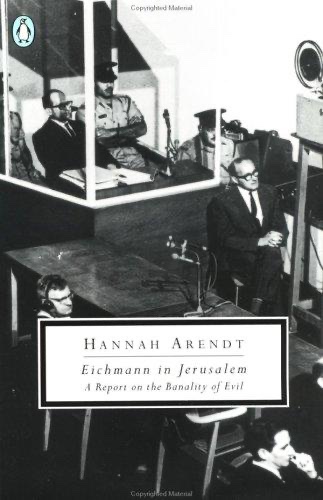
Cover of Eichmann in Jerusalem

Eichmann in Jerusalem

Hannah Arendt

6 ideas

  1. Banality of evil as thoughtlessness

    Monstrous deeds can be carried out by people who are not monsters. Eichmann's defining trait was not malice but the absence of reflection on what he was doing, which let him commit catastrophic harm while feeling like an ordinary functionary.

  2. Inability to think from another's standpoint

    Arendt ties Eichmann's inability to speak except in clichés to an inability to think, meaning to imagine a situation from anyone else's point of view. Stock phrases and bureaucratic language shielded him from reality. The failure to take another's perspective is a moral failure that works through a cognitive one.

  3. Language rules as reality-screening euphemism

    The Nazi regime required coded terms such as 'final solution,' 'evacuation,' and 'special treatment' in place of plain words for killing. The code did not so much hide the facts from outsiders as keep perpetrators from matching their actions to their ordinary moral knowledge. Controlling vocabulary let participants do what they would have recognized as murder under its real name.

  4. Careerism substitutes for conviction in atrocity

    Eichmann's main motives were promotion, diligence, and wanting his superiors' approval, not antisemitic zeal. Ordinary ambition and conscientious job performance, placed inside a criminal system, become the engine of mass crime.

  5. Legality inverts conscience in criminal states

    Under a regime where the law itself commands murder, conscience and legality trade places. Obeying the law, which Eichmann framed through a distorted Kantian duty, becomes the crime. Refusing becomes the moral act, and the temptation a person must resist is the temptation not to kill. Individual judgment therefore cannot be handed off to legal authority, and a person remains responsible even when every rule told them to act.

  6. Cog defense rejected by individual responsibility

    A court judges a person, not a system, so the claim that 'if I hadn't done it, someone else would have' does not remove guilt. Arendt argued that in politics, obedience amounts to support. Seeing a functionary as a replaceable cog explains how the bureaucracy worked but does not excuse the person who chose to fill that role.

Save and mark ideas in the app