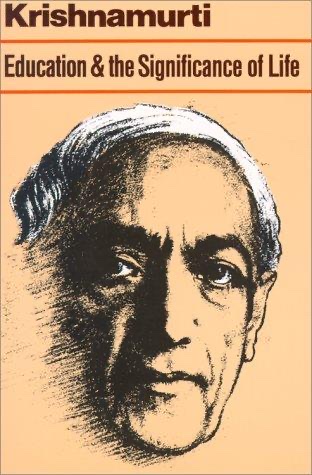
Cover of Education and the Significance of Life

Education and the Significance of Life

6 ideas

Buy on Amazon
  1. Education trains fear and conformity, not intelligence

    Conventional education, by emphasizing technique, examinations, and the accumulation of information, conditions the mind to conform and to seek security rather than to understand itself. This produces efficient specialists and clerks but not integrated human beings, because it cultivates the pursuit of success and status, which is rooted in fear.

  2. Integration as the aim of right education

    The purpose of education is not to turn out a specialist but to produce an integrated human being who is capable of dealing with life as a whole, not in fragmented compartments. Integration means the harmonious functioning of thought, feeling, and action without the inner division created by pursuing ideals or conforming to patterns.

  3. The educator must educate himself first

    A teacher conditioned by fear, nationalism, and the craving for security can only transmit that same conditioning, regardless of method or curriculum. Right education therefore depends on the educator understanding and freeing himself, because what the teacher is matters more than what he teaches.

  4. Ideals are an escape from what is

    Pursuing an ideal or a future 'what should be' distracts attention from understanding the actual present fact, creating a gap between the real and the imagined that breeds conflict and hypocrisy. Only by giving full attention to what actually is, without the screen of an ideal, can there be transformation.

  5. Self-knowledge as the beginning of freedom

    Intelligence and freedom arise not from accumulated knowledge but from understanding the whole process of oneself: one's responses, fears, desires, and the operation of thought moment to moment. This understanding cannot be taught as a system; it comes through watchful awareness in relationship.

  6. Discipline and reward suppress understanding

    Imposed discipline, punishment, and reward shape conduct through compulsion and comparison, which only conditions the child and breeds resistance or submission rather than genuine understanding. Real order arises when the child understands the significance of an action for himself, not when behavior is enforced from outside.

Save ideas and give them a thumbs up or down in the app