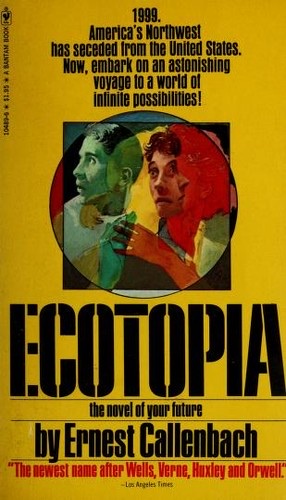
Cover of Ecotopia

Ecotopia

Ernest Callenbach

4 ideas

  1. Skeptical journalist converts inside Ecotopia

    In 1999, twenty years after Northern California, Oregon and Washington seceded, the New York journalist William Weston becomes the first American reporter officially admitted to Ecotopia. His dispatches to his paper begin condescending, while his private notebooks record his growing absorption. After an affair with the Ecotopian woman Marissa Brightcloud and a stay in a hospital, he decides to stay rather than return home, so the book's argument is carried by an outsider whose resistance slowly gives way.

  2. Stable-state economy trades growth for leisure

    Ecotopia deliberately accepts a lower material standard of living in exchange for a twenty-hour work week, balanced ecological inputs and outputs, and full recycling. The book argues that once growth stops being the goal, productivity gains can be taken as free time rather than more consumption. That frees people for craft, community and bodily pleasure.

  3. Ritual war games channel male aggression

    Ecotopians hold periodic ritual war games in which young men fight with spears, and injuries and occasional deaths are accepted. The society's premise is that aggression is biological and cannot be abolished, so it is given a bounded, ceremonial outlet.

  4. Dual texts expose official versus felt truth

    The novel alternates Weston's published newspaper columns with his private diary. The gap between what a reporter tells his audience and what he actually experiences becomes the measure of ideological capture and of change. Read this way, any account of a foreign system has to be checked against the observer's incentives to keep their home frame intact.

Save and mark ideas in the app