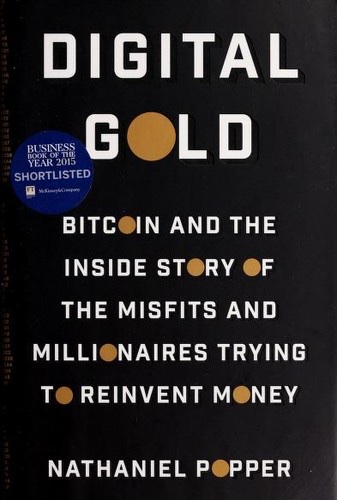
Cover of Digital Gold

Digital Gold

Nathaniel Popper

4 ideas

  1. Silk Road gives Bitcoin its first economy

    Ross Ulbricht launched Silk Road in early 2011 as a Tor-hidden drug marketplace that took only bitcoin, later running it under the name 'Dread Pirate Roberts'; it gave the currency its first sustained real-world demand, and a June 2011 Gawker article about the site set off a price spike and a wave of new users. Ulbricht's October 2013 arrest in a San Francisco public library tied Bitcoin's public identity to crime even as the site had shown the currency could work as money.

  2. Proof-of-work solves double-spending without trust

    Earlier cypherpunk attempts at digital cash, such as DigiCash, b-money and bit gold, either depended on a central issuer or never solved how to stop the same digital coin from being spent twice. Satoshi combined a public ledger, cryptographic signatures and computationally expensive 'mining' so that the whole network agrees on one transaction history. New coins paid to miners give strangers a self-interested reason to maintain that history honestly.

  3. Intermediaries reintroduce the trust Bitcoin removed

    Bitcoin removes the need to trust a bank, but most users bought and stored coins through exchanges, which recreated a single point of failure without regulation or safeguards. Mt. Gox was run by Mark Karpelès in Tokyo, handled most global bitcoin trading at its peak, and collapsed in February 2014 with roughly 850,000 bitcoins missing. The protocol's trustlessness did not extend to the institutions built around it.

  4. Movements shift from ideologues to capital

    Bitcoin's first stewards were anti-state cypherpunks and libertarians who valued it as a tool against government and banks. As the price rose, entrepreneurs and venture investors arrived, including Coinbase's founders and the Winklevoss twins. They courted regulators and framed Bitcoin as payment infrastructure, so the technology's meaning shifted with whoever had the resources to build on it, often in tension with its founding ideals.

Save and mark ideas in the app