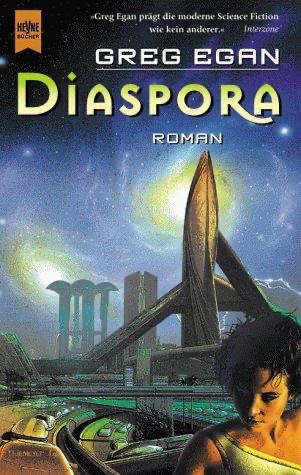
Cover of Diaspora

Diaspora

Greg Egan

4 ideas

  1. Lacerta burst ravages an unprepared Earth

    The polises learn that two neutron stars in Lacerta will collide about seven million years earlier than their astronomers predicted, and the resulting gamma-ray burst ravages Earth and devastates the flesh humans who stayed behind. The software citizens survive but cannot explain why their models failed, and that failure launches the Diaspora: clones sent across the galaxy to find the missing physics.

  2. Wang's Carpets: minds as tiling computation

    On a planet orbiting Vega the explorers find a mat of polymer tiles floating in an ocean, and the chemistry of those tiles works like Wang tiles, so the whole carpet functions as a universal computer. Its dynamics, read through a Fourier transform, turn out to hold complex creatures living in a high-dimensional space, even though the carpet itself has no sensors and no awareness of the outside world. The idea is that a mind can exist purely as a pattern inside a substrate that looks inert, so searching for life by its biology can walk right past it.

  3. Outlooks let minds reinforce chosen values

    Polis citizens can use software called outlooks to reinforce chosen values and emotional responses, holding interest or conviction steady against drift. The novel treats this as deliberate self-authorship, and through Inoshiro's particular outlook it shows a case where a value lock becomes effectively irreversible and closes the mind to persuasion.

  4. Inquiry continues after the pursuit ends

    The expedition follows the burst's cause through higher-dimensional universes until the burst is explained and the pursuit of the Transmuters ends. Afterward, many participants settle or stop, while Yatima goes on to explore mathematics and the invariants of vis own consciousness, pursuing understanding for its own sake.

Save and mark ideas in the app