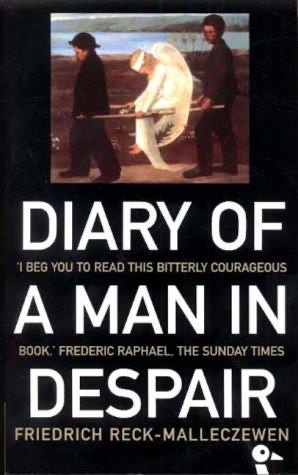
Cover of Diary of a Man in Despair

Diary of a Man in Despair

Friedrich Reck-Malleczewen

4 ideas

  1. The unfired pistol at Osteria Bavaria

    Reck recalls sitting near Hitler in Munich's Osteria Bavaria restaurant in 1932, carrying a loaded revolver while Hitler sat almost unguarded, and not shooting him because he did not foresee what was coming. He records this as his lasting guilt, a private test of what an individual owed history when the danger was still small. The diarist who condemned the whole regime from 1936 onward was himself arrested in 1944 and died in Dachau in early 1945.

  2. Nazism as revolt of mass man

    Reck argues that Nazism is not an excess of conservatism but its opposite: a product of uprooted, mechanized, urban 'mass man' cut off from faith, land and inherited hierarchy. On this view, the more a society dissolves traditional bonds into atomized crowds fed by propaganda and technology, the more readily it produces a demagogue who embodies the crowd's resentments. This lets a reactionary Catholic monarchist oppose Hitler from the right rather than the left.

  3. Totalitarianism as recurring collective psychosis

    Reck reads Hitler's Germany through the 1534–35 Anabaptist takeover of Münster under Jan Bockelson, the tailor-prophet who seized the city and ruled it through terror and messianic promises. Seeing mass movements as outbreaks of a recurring collective madness, rather than as rational politics, shifts attention to their shared pattern: a nobody-turned-prophet, apocalyptic promises, terror against doubters and eventual self-destruction. Reck used this parallel as coded criticism in his 1937 book on Bockelson.

  4. Late resistance is opportunism, not conscience

    Reck scorns the generals and officials behind the 20 July 1944 plot: they had served Hitler through years of crime and moved against him only when military defeat became certain. He contrasts them with the young students of the White Rose, who resisted in 1943 at the cost of their lives without hope of success. On his account, the moral worth of an act of resistance depends on when it comes, and turning on a doomed regime is self-preservation.

Save and mark ideas in the app