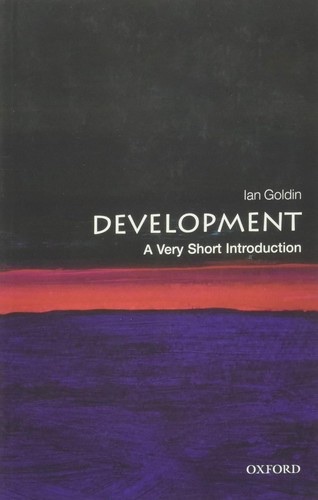
Cover of Development: A Very Short Introduction

Development: A Very Short Introduction

6 ideas

Buy on Amazon
  1. Development exceeds income to include capabilities

    Development is not reducible to GDP growth; it encompasses health, education, political freedom, and the expansion of what people are actually able to do and be. A country can raise average income while leaving large groups unable to lead lives they value, so measuring progress requires tracking distribution and human capability, not output alone.

  2. Multiple drivers, no single growth recipe

    Sustained development arises from the interaction of several factors, institutions, trade, investment in health and education, infrastructure, and stable governance, rather than from any one lever. Because these factors reinforce each other and depend on context, policies that worked in one country often fail when transplanted without adaptation.

  3. Rapid convergence shows poverty is not permanent

    The sharp fall in global poverty and the rapid rise of economies like China, South Korea, and others demonstrate that under-development is historically reversible rather than a fixed condition. This refutes fatalistic accounts and shifts the question from whether development is possible to which combinations of policies and conditions accelerate it.

  4. Aid judged by its systemic effects

    Foreign aid should be evaluated not by amounts transferred but by whether it builds local capacity or instead creates dependency, distorts governance, and substitutes for domestic accountability. The same money can help or harm depending on how it interacts with recipient institutions and incentives.

  5. Globalization as uneven double-edged force

    Integration into global trade and capital flows can accelerate development by opening markets and spreading technology, yet it simultaneously exposes economies to external shocks, volatile capital, and competition that can entrench disadvantage. The outcome depends on a country's capacity to manage openness, so globalization is neither uniformly beneficial nor uniformly harmful.

  6. Development now constrained by planetary limits

    Future development cannot replicate the resource-intensive, high-carbon path of already-rich countries because climate change and environmental limits are shared and finite. This creates a tension in which the countries that contributed least to the problem face the greatest pressure to develop differently, making sustainability a condition of development rather than an optional add-on.

Save ideas and give them a thumbs up or down in the app