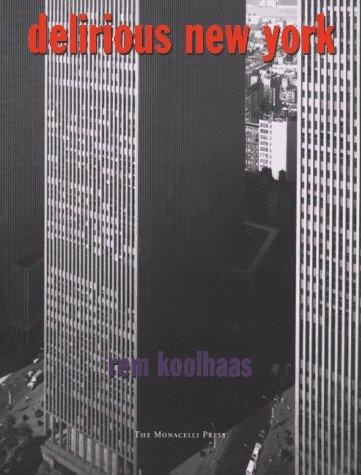
Cover of Delirious New York

Delirious New York

Rem Koolhaas

5 ideas

  1. Retroactive manifesto for an unwritten theory

    Manhattan was built without a declared program, so Koolhaas reconstructs its governing theory after the fact from the buildings themselves. The manifesto is read out of accumulated evidence rather than proposed in advance, treating the built city as the proof of a doctrine its builders never stated.

  2. Culture of congestion as urban program

    Manhattanism celebrates maximum density of people, activities and fantasies on a finite site as a positive goal rather than a problem to be relieved. Congestion is engineered deliberately, because the collision of unrelated programs in close proximity generates new forms of metropolitan life.

  3. The grid liberates by constraining every block

    The 1811 Commissioners' Plan divides the island into identical blocks, and that neutrality turns each block into an autonomous island whose contents are uncontrolled. Rigid two-dimensional order licenses total three-dimensional anarchy, since the grid dictates only the footprint and never the program.

  4. Coney Island as Manhattan's rehearsal laboratory

    The amusement parks at Coney Island, including Luna Park and Dreamland, tested technologies of artificial experience such as electric light, mechanical rides and simulated disasters on a mass audience. These experiments in fabricated fantasy and density were then transferred to Manhattan, where the same apparatus was applied to everyday urban life at architectural scale.

  5. Le Corbusier's failed rationalization of Manhattan

    Le Corbusier saw Manhattan's skyscrapers as too small and chaotic and proposed replacing congestion with isolated towers in open parkland. Koolhaas presents this as a European misreading that tries to cure the city of the density that gives it life, set against Dalí, who embraced Manhattan's irrational fantasy.

Save and mark ideas in the app