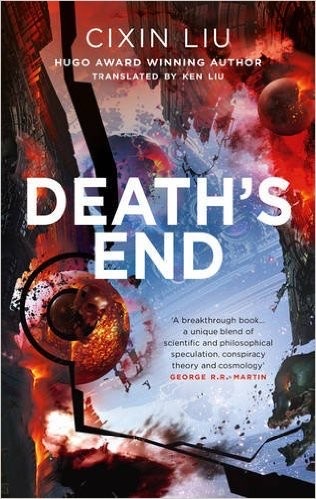
Cover of Death's End

Death's End

Liu Cixin

4 ideas

  1. Cheng Xin's fifteen minutes as Swordholder

    Luo Ji kept the Trisolarans at bay for decades as Swordholder, holding a switch that would broadcast both worlds' locations and doom them both. Trisolaris had assessed her as unlikely to fire and attacked within minutes of the handover; she did not press the switch, and deterrence collapsed at once, leaving Earth disarmed.

  2. Only proven incapacity counts as harmless

    Under dark-forest logic, a civilization's stated peaceful intent is worthless, because others cannot verify intent and cannot rule out that it will change. The only credible signal of harmlessness is to physically remove one's own capacity to threaten. In the novel this means slowing light speed around one's star system to form a 'black domain' that nothing can leave. Safety is bought with permanent self-imprisonment, which makes survival and freedom directly opposed.

  3. Physical law as the ultimate weapon

    Advanced civilizations fight by altering the structure of spacetime itself. An example is the dual-vector foil, which collapses a region of three-dimensional space into two dimensions. It flattens the entire Solar System, and it is deployed casually by a low-level 'cleaner'. The cumulative cost of such warfare is that the universe itself degrades: it drops from ten dimensions toward fewer, and light slows. Cosmic war becomes a slow suicide of the shared environment.

  4. Layered metaphor to evade total surveillance

    Yun Tianming, a human held captive by the Trisolarans, cannot pass intelligence directly because every message he sends is monitored. He embeds it in three fairy tales whose surface reads as harmless children's stories, while their images hide double and triple meanings. Some of those meanings point to curvature propulsion and to black domains. Decoding them requires the receiver to share cultural context the watcher lacks, so that shared context becomes the encryption key.

Save and mark ideas in the app