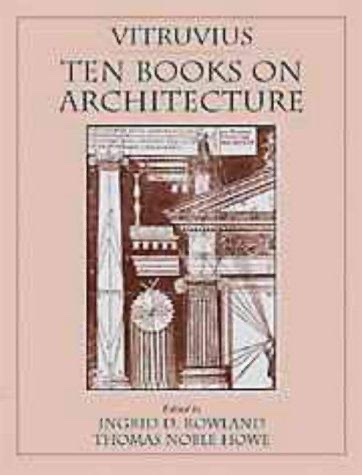
Cover of De Architectura

De Architectura

Vitruvius

3 ideas

  1. Firmness, Commodity, Delight as Building Test

    Every building must be judged on three simultaneous requirements: firmitas (it stands, through sound foundations and materials chosen without stinting), utilitas (its arrangement serves its use without obstruction), and venustas (its appearance pleases through proper proportion). A work that satisfies only one or two is deficient, so the three act as a checklist that no single virtue can override.

  2. Symmetry Derived from the Human Body

    Vitruvius defines symmetria as the agreement of every part with the whole through a common module, so that each member is a fixed fraction of a base unit, such as the column diameter. He grounds this in the well-formed human body, whose parts stand in set ratios (the face as a tenth of the height) and which, arms outstretched, fits inside both a circle and a square. A temple is well proportioned when its elements relate to one another as the body's members do.

  3. Architects Need Both Theory and Practice

    Vitruvius argues that an architect trained only by hand lacks authority because he cannot explain or justify his work, while one trained only in reasoning chases a shadow because he cannot execute. The architect therefore needs broad learning in drawing, geometry, history, philosophy, music, medicine, law, and astronomy. Each discipline bears directly on building, from acoustics in theaters to healthy siting and water rights.

Save and mark ideas in the app