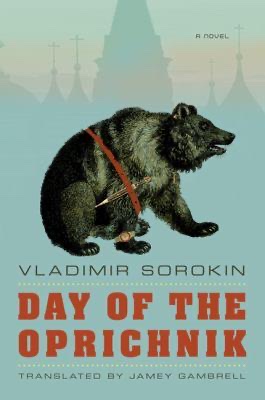
Cover of Day of the Oprichnik

Day of the Oprichnik

Vladimir Sorokin

4 ideas

  1. One working day of oprichnik Komiaga

    In a 2028 Russia ruled by a restored tsar and walled off from the West, oprichnik Andrei Komiaga begins his day by raiding a disgraced nobleman's estate: the man is hanged, his wife is raped by the squad, and the house is burned. He then handles censorship of a stage performance, collects bribes from Chinese trade traffic, consults a court clairvoyant, takes a hallucinogenic drug, and ends the night in a ritual bathhouse orgy with his brotherhood. The atrocity and the paperwork carry the same flat weight, which makes the case evidence that state terror can run as routine administrative work.

  2. Sacred ritual launders state violence

    The oprichniks cross themselves, pray, speak in archaic Orthodox and folk formulas, and cast their raids as service to God and Tsar. Wrapping repression in inherited sacred forms turns the perpetrator's acts into duty and piety, so he does not experience them as crimes. Tradition works less as belief than as moral anesthetic for the enforcer.

  3. Shared transgression as brotherhood bonding ritual

    The brotherhood is bound together by acts committed in common, from group violence during raids to a collective sexual ritual led by their chief. In the novel these shared transgressions work as bonding rites, producing solidarity and collective ecstasy alongside Komiaga's evident conviction and devotion to the chief, rather than in place of them.

  4. Modern technology serving feudal restoration

    The novel pairs holograms, advanced cars with severed dog heads mounted on the bumpers, and gas-export and Chinese trade dependence with serfdom-style hierarchy, a border wall, and Ivan the Terrible's terror apparatus. Seen this way, modernization and archaism are not opposites: a regime can import tools and cash flows while using them to rebuild premodern relations of rank, fear, and personal rule. Technological sophistication is no indicator of political progress.

Save and mark ideas in the app