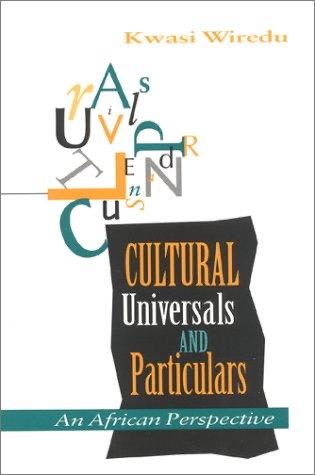
Cover of Cultural Universals and Particulars

Cultural Universals and Particulars

Kwasi Wiredu

5 ideas

  1. Conceptual decolonization through native-language testing

    African thinkers trained in colonial languages have absorbed Western philosophical categories without examining them. The corrective is to restate each problem in one's own language, such as Akan. If the problem cannot be stated intelligibly there, that suggests it is an artifact of one language's grammar rather than a universal problem, and it should not be inherited uncritically.

  2. Descartes' cogito strained in Akan

    When 'I think, therefore I am' is rendered in Akan, the existential verb 'wo ho' means 'to be there, at some place,' so the conclusion reads as 'I am located somewhere.' Wiredu uses this to question whether Descartes' inference to a thinking thing without spatial location is coherent, treating the tension as grounds for further scrutiny rather than a conclusive refutation. The Akan okra and adwene are understood as quasi-physical or functional rather than immaterial substances, which is why the mind–body problem does not arise in the same form.

  3. Akan separates truth from truthfulness

    Akan distinguishes nokware, meaning truthfulness or the absence of lying, from cognitive truth, which is expressed as 'it is so' (ete saa), and has no single word matching the English 'truth' as correspondence with 'facts.' Wiredu uses this distinction to suggest that the correspondence theory's machinery of facts and truth-bearers may reflect English idiom rather than a necessary feature of thought.

  4. Universals rest on shared human biology

    Cross-cultural understanding is possible because all humans share a biological constitution that grounds common cognitive and moral capacities. The core universal moral rule is sympathetic impartiality: give equal consideration to others' interests as if you were in their position. Customs such as etiquette, taboos and rituals are legitimately particular. Error arises when one culture's customs are presented as universal morality.

  5. Personhood as a normative achievement

    In Akan thought, being an onipa (person) in the full sense is not guaranteed by being biologically human. It is earned by fulfilling obligations to family and community. One can therefore say of someone who behaves badly 'he is not a person,' which makes personhood a graded moral status embedded in relationships rather than a metaphysical given.

Save and mark ideas in the app