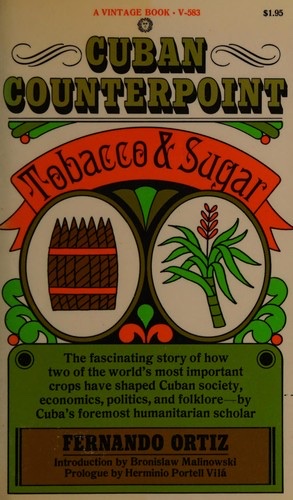
Cover of Cuban Counterpoint: Tobacco and Sugar

Cuban Counterpoint: Tobacco and Sugar

Fernando Ortiz

6 ideas

  1. Transculturation as loss, fusion, and creation

    Transculturation is the process where two cultures meet and each loses parts of itself, the surviving pieces fuse, and something new comes out that belongs to neither parent. Ortiz coined the term to replace 'acculturation,' which implies a one-way adoption of the dominant culture by the subordinate one. The mechanism has three phases happening at once: deculturation (loss), mutual adaptation, and neoculturation (emergence of a new form).

  2. A commodity's growing needs shape its society

    How a crop has to be grown and processed produces a matching social order. Tobacco needs careful individual attention to each leaf, small plots and expert judgment, so it produced independent smallholders and skilled artisans. Sugar needs huge acreage, heavy machinery and mass gang labor, so it produced latifundia, slavery, and concentrated capital.

  3. Sugar mechanization drives foreign ownership and monoculture

    As sugar mills industrialized, the capital needed for a competitive central outgrew what local owners could raise. Ownership moved to foreign, mainly U.S., corporations, and land swallowed into vast estates pushed Cuba toward monoculture. The more efficient the industry became, the more national autonomy and diversified smallholding it destroyed.

  4. Paired opposites as analytical method

    Ortiz sets tobacco and sugar against each other across many contrasts, such as dark versus white, native versus imported, individual versus mass, and quality versus quantity, so that Cuban society's tensions become readable through the pair. He models the device on the medieval debate poem, a musical-style counterpoint. He closes it not in lasting opposition but with the two joined in a union that produces alcohol.

  5. Tobacco's journey from sacred to secular

    Among the Taíno, tobacco was a ritual substance used by shamans for healing, divination, and contact with spirits. When Europeans took it up it turned into a profane habit and then a taxed, globally traded pleasure commodity. The crop's history shows how an object's meaning changes completely as it crosses cultures, while traces of the original magic stay attached to it.

  6. Cuban identity formed through repeated uprootings

    Cuba's population is made up of successive waves of uprooted peoples: Indigenous inhabitants who were wiped out, Spanish conquerors, enslaved Africans from many nations, Chinese laborers, and others. Each group was torn from its home culture and forced to rebuild in a new setting. National identity is therefore not a fixed inheritance but the ongoing, unfinished result of this collective transculturation.

Save and mark ideas in the app