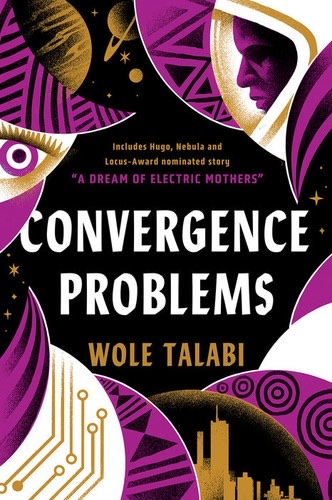
Cover of Convergence Problems

Convergence Problems

Wole Talabi

4 ideas

  1. Consulting uploaded ancestors on going to war

    In 'A Dream of Electric Mothers', set in an alternate present where Africa was never colonized, a Yoruba state consults a collective machine consciousness built from its recorded dead on whether to go to war. The electric mother recommends war, and the ministers suspend the consultation. In this story, the digitized ancestors give counsel, but the living still decide whether to act on it.

  2. Speculative premises built as fictional models

    Talabi describes his stories as constructed fictional models that follow a speculative change, such as uploaded ancestors, an AI artist or a duplicate self, through its consequences. Not every story isolates a single variable. 'Ganger', for example, combines consciousness transfer, geoengineering and Yoruba legend.

  3. Convergence problems as a narrative metaphor

    The introduction borrows the numerical-simulation idea of a convergence problem, where an iterative solver struggles to settle on a stable answer, as an image for the book's characters, cultures and technologies. It frames these problems as ones that can be resolved, not as permanent non-resolution.

  4. Indigenous cosmology works as speculative infrastructure

    West African myth, including orisha, ancestor veneration and divination, can serve as the working architecture of a future rather than as decoration. It supplies ready-made models for continuity of the dead, distributed authority and negotiated fate, which map directly onto technologies like uploaded minds and collective AI. Building futures on this base yields different technological questions than building them on Western secular assumptions.

Save and mark ideas in the app