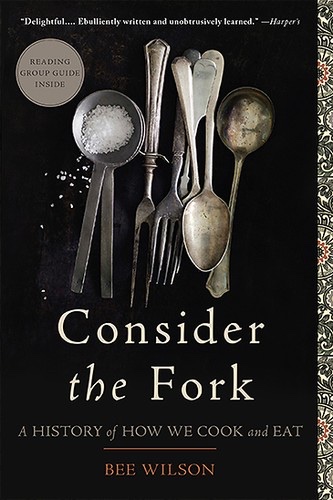
Cover of Consider the Fork

Consider the Fork

Bee Wilson

6 ideas

  1. Table knives and forks reshaped European bites

    Anthropologist C. Loring Brace found that the modern overbite, where the top incisors overhang the bottom, appeared in Europeans only about 250 years ago, roughly when table knives and forks became common. Before that, people clamped meat in their front teeth and sawed off pieces, which kept the incisors meeting edge to edge; once cutlery pre-cut food into small morsels, the jaw developed differently. Cutlery changed human anatomy, not just manners.

  2. Cooking pots let the toothless survive

    Before vessels for boiling, food had to be roasted or eaten raw, and both require strong teeth. Pottery made soft porridges, stews and broths possible, which could feed weaned infants and elderly people who had lost their teeth. By extending how long people could live and be cared for, the humble pot changed survival rates and social structure.

  3. Where cutting happens defines a cuisine

    Chinese cooking relies on the tou, a single all-purpose cleaver, to cut everything into bite-sized pieces in the kitchen, so chopsticks are all that is needed at the table. European cooking brought large joints to the table and left cutting to each diner with a knife. The division of labor between cook and eater, set by the knife, shapes dish forms, cooking methods such as fast stir-frying that saves fuel, and dining etiquette.

  4. Cup measures traded accuracy for accessibility

    American cookery standardized on volume measures in cups, popularized by Fannie Farmer, while much of Europe weighs ingredients. Cups are less precise because flour compacts and chopped foods pack unevenly, but they were cheap, required no scale, and gave home cooks confidence. Measuring systems persist because of their cultural and democratic appeal, not because of their accuracy.

  5. Ice trade and the refrigerated food chain

    Cold storage later separated food from season and place. It made fresh meat, milk and produce transportable across distances, and it shifted cooking away from preservation methods such as salting, smoking and pickling toward freshness.

  6. Successful kitchen technology becomes invisible

    The most transformative kitchen tools, such as the wooden spoon, the pan, the fork and the measuring cup, have become so ordinary that we no longer see them as technology at all. Only novel gadgets register as innovation. Examining these unnoticed tools shows that they encode choices about labor, class, danger and taste, including who turns the spit and how much fuel a cuisine can afford.

Save and mark ideas in the app