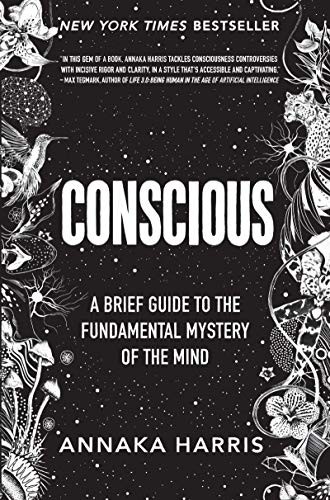
Cover of Conscious: A Brief Guide to the Fundamental Mystery of the Mind

Conscious: A Brief Guide to the Fundamental Mystery of the Mind

6 ideas

Buy on Amazon
  1. The hard problem of consciousness

    There is an explanatory gap between describing the brain's physical processing and explaining why any of that processing is accompanied by subjective experience at all. Even a complete account of neural mechanisms would not tell us why information processing feels like something from the inside rather than proceeding in the dark.

  2. Two intuitions that mislead us about consciousness

    We reflexively assume consciousness is causal (it steers our behavior) and that it is reliably signaled by complex behavior. Both assumptions may be false: experience could accompany processing without driving it, and a system could behave intelligently with or without any inner experience, so our usual cues for detecting consciousness are unreliable.

  3. Behavior is not proof of consciousness

    Because we only ever have direct access to our own experience, we cannot confirm consciousness from the outside in any other system, whether another person, an animal, or a machine. Complex, goal-directed behavior is evidence we habitually trust, but it does not logically guarantee that an inner experience is present.

  4. Consciousness as possibly fundamental

    Instead of treating experience as something that emerges once matter reaches sufficient complexity, we can entertain that consciousness is a basic feature of the universe, like mass or charge. Under this panpsychist-style lens, the question shifts from how experience arises to how simple forms of experience combine into the rich minds we know.

  5. Split-brain patients and divided experience

    In patients whose hemispheres are surgically separated, each half can respond to information the other half cannot report, acting as though two centers of awareness coexist in one skull. This case suggests the felt unity of a single self may be a construction rather than a given, and that consciousness need not map onto one indivisible subject.

  6. The self as a felt illusion

    The sense of being a unified, continuous agent who authors thoughts can come apart from experience itself: consciousness can persist while the feeling of a separate self dissolves, as in certain meditative states. This implies the self is a particular content of experience rather than the experiencer, so losing it need not mean losing awareness.

Save ideas and give them a thumbs up or down in the app