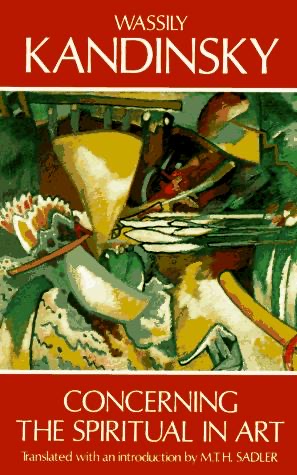
Cover of Concerning the Spiritual in Art

Concerning the Spiritual in Art

Wassily Kandinsky

6 ideas

  1. Inner necessity as the governing principle

    A colour or form belongs in a work only if it is required by the inner content the artist must express, not because it resembles an object or pleases the eye. The artist's choices are 'right' when they produce the intended vibration in the viewer's soul, so outward rules of composition or likeness hold only when they serve that inner effect.

  2. Physical and psychic effects of colour

    Colour first acts physically, as a sensory impression of pleasure or irritation that is superficial and fades once the eye turns away. In more developed sensibilities it also produces a psychic effect, a vibration in the soul. Kandinsky grants that association explains part of this, but he holds that it cannot fully account for colour's direct influence on the soul.

  3. Warm-cold and light-dark colour movements

    Colours can be read as motions. Warm yellow spreads outward toward the viewer and feels aggressive and earthly. Cold blue withdraws inward and deepens toward the spiritual. A second axis runs from light to dark, which adds or removes possibility. Under this lens a colour stops being a hue and becomes a force pressing on or pulling from the viewer.

  4. Painting should aspire to music's abstraction

    Music already expresses inner life directly, without imitating nature. Painting should likewise free colour and form from representation so they act the way tones and chords do. Colours have timbres, so yellow is like a trumpet and deep blue like a cello or organ, and a canvas can be composed as a symphony rather than a depiction.

  5. The spiritual triangle of progress

    Human spiritual life is a triangle moving slowly upward. At its narrow apex stand a few visionaries, often artists, who see what later becomes common sense. Each level ridicules the one above it until the whole triangle rises to occupy that place. This explains why genuine new art is initially rejected and later accepted.

  6. Form carries content independent of objects

    Every form, even a bare triangle or circle, has its own inner sound or spiritual character. Placing a colour inside a form changes the effect of both, so a sharp yellow triangle reinforces while a blue triangle creates tension. Because form alone speaks, removing the recognisable object does not empty a painting. It exposes the expressive elements the object was hiding.

Save and mark ideas in the app