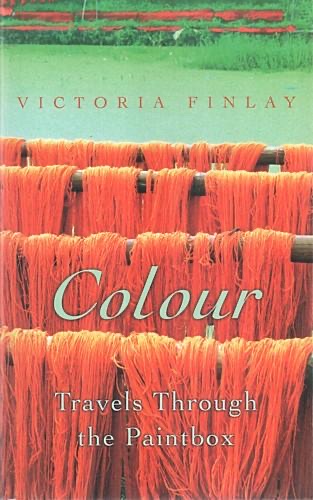
Cover of Colour: Travels Through the Paintbox

Colour: Travels Through the Paintbox

Victoria Finlay

4 ideas

  1. Cochineal's secret and Thiéry de Menonville's smuggling

    After conquering Mexico, Spain made the cochineal insect, farmed on nopal cacti in Oaxaca, a trade monopoly that for centuries produced Europe's most prized red and one of its most valuable imports after silver. Many Europeans were unsure whether the dye came from a seed, a berry or a worm. In 1777 the French botanist Nicolas-Joseph Thiéry de Menonville smuggled live insects on cactus pads out of Oaxaca to Saint-Domingue in an attempt to break the monopoly.

  2. Pigment cost dictated what paintings could mean

    Ultramarine was ground from lapis lazuli mined in Afghanistan's Badakhshan region and carried across continents, so it could cost more than gold by weight. Because of that expense, patrons' contracts often specified how much ultramarine a painting must use, and painters reserved it for the most sacred elements, such as the Virgin Mary's robe. The economics of supply therefore shaped religious iconography, not just aesthetic preference.

  3. The poisonous price of beautiful colour

    Many of history's most brilliant pigments were made from toxic materials, such as lead white and the arsenic-based Scheele's green, and they harmed the workers who made them and the painters and householders who lived with them. In some cases these pigments stayed in use even after their dangers were known, because the colour was so desirable. One much-discussed case is the hypothesis that arsenic vapour from green wallpaper contributed to Napoleon's decline on St Helena.

  4. Synthesis can erode a colour's exclusivity

    Part of a colour's prestige came from how hard it was to obtain, and when chemistry made rare colours cheaper, some of their exclusive associations weakened. Examples include the synthetic ultramarine that won J.-B. Guimet a French prize in 1828 and William Perkin's accidental 1856 discovery of mauveine, which made purple far more widely available than the laborious Tyrian dye made from murex snails. Asking what a colour cost to make in a given era can help explain what it meant.

Save and mark ideas in the app