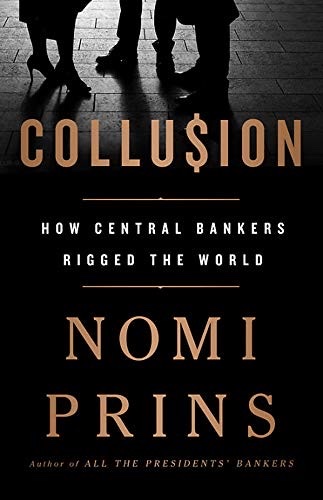
Cover of Collusion

Collusion

Nomi Prins

5 ideas

  1. Central banks acted as a coordinated cartel

    After 2008 the Fed, ECB, Bank of Japan, and Bank of England moved in concert through synchronized rate cuts, swap lines, and parallel QE programs rather than as independent national authorities. Because each central bank's easing reinforced the others, the combined effect was a global flood of cheap money that no single central bank would have produced on its own.

  2. Quantitative easing as asset price inflation

    QE works by central banks buying government bonds and mortgage securities, which pushes yields down and forces investors into riskier assets like stocks, corporate debt, and real estate. The money mostly inflates financial asset prices instead of flowing into wages or productive lending. It therefore benefits people who already own assets.

  3. Emergency policy became a subsidy to big banks

    Near-zero rates and central bank balance-sheet support let the largest banks borrow almost for free, rebuild reserves, and profit from trading and buybacks without having to restructure or shrink. The rescue measures were supposed to be temporary but became permanent. That removed the market discipline that would have punished the institutions that caused the crisis.

  4. Taper tantrum hit emerging markets hard

    When the Fed hinted in 2013 that it would slow its bond purchases, capital that had flowed into emerging markets such as Brazil, India, and Turkey during QE pulled back out, adding pressure on their currencies. The episode shows how countries that did not set US policy absorbed some of its volatility, alongside their own domestic pressures.

  5. Cheap money creates a dependency trap

    Once markets are priced on the assumption of near-zero rates and continuous central bank support, any attempt to normalize policy threatens a crash. That pressure pushes central banks to keep easing. The result is a ratchet in which stimulus grows at each crisis and is never fully withdrawn, leaving the system more fragile and more reliant on central bank intervention.

Save and mark ideas in the app