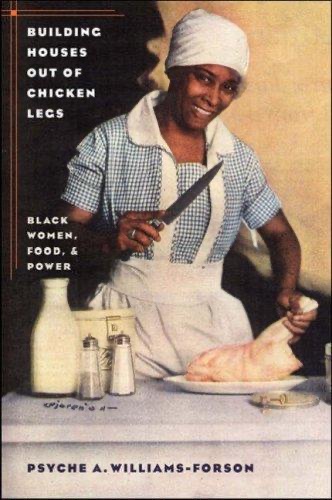
Cover of Building Houses out of Chicken Legs

Building Houses out of Chicken Legs

Psyche Williams-Forson

5 ideas

  1. Gordonsville waiter carriers selling chicken trains

    After the Civil War, Black women in Gordonsville, Virginia sold fried chicken, biscuits, pies and coffee through the windows of trains stopped at the depot. The trade needed only a kitchen, local poultry and a railway timetable. With it these women earned cash, bought property and supported families in a region that offered them almost no other paid work besides domestic service.

  2. One food carries both independence and insult

    Fried chicken served as a means of Black women's economic self-sufficiency and also as a symbol used to demean Black people. Its meaning is not fixed in the food but depends on who controls its representation, and the book shows that this is not a simple split along racial lines, since Black artists, including Black women, can also misrepresent Black women through it.

  3. Racist chicken caricature as visual commodity

    Postcards, minstrel shows, trade cards and advertisements repeatedly showed Black people stealing or gorging on chicken. This turned a real economic practice into proof of supposed appetite, dishonesty and childishness. Because the imagery was mass-produced and sold, the stereotype circulated as entertainment and made money for its white producers while it degraded its subjects.

  4. Reading food as material culture

    Treat a dish as an artifact embedded in labor, trade, ritual and representation, not simply as nourishment. Asking who raises it, who cooks it, who sells it, who eats it and who depicts it shows power relations and forms of resistance that written records often omit, especially for Black women whose lives were poorly archived.

  5. Shoebox lunches for travel under segregation

    During Jim Crow, Black travelers could be refused service at restaurants along the road and at rail stations. Many packed fried chicken and other food that kept well into shoeboxes before a journey. This home-cooked provision let them avoid humiliation and danger, and it made cooking into infrastructure for mobility under segregation.

Save and mark ideas in the app