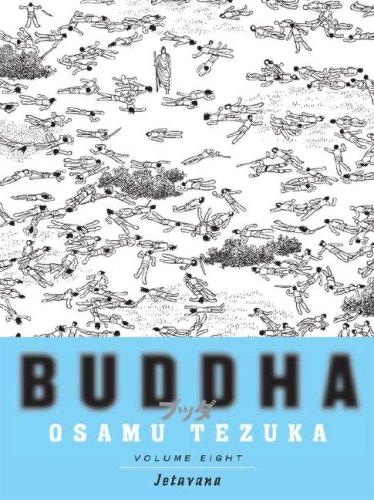
Cover of Buddha

Buddha

Osamu Tezuka

4 ideas

  1. Chapra: the slave who hid his caste

    Chapra, a slave-caste boy, saves a Kosalan general, Budai, and is adopted by him. He rises to become a celebrated warrior under a false Kshatriya identity while hiding his real mother. When his origins are exposed, he and his mother are executed together. His talent and service could not overcome the birth status the society treated as fixed.

  2. The rabbit who leapt into fire

    A starving holy man collapses in the snow, and a bear, a fox and a rabbit try to feed him. The bear and fox bring food; the rabbit has nothing to offer, so it throws itself into the fire so its body can become his meal. The episode frames the whole work: the highest giving is offering oneself, with no expectation of return.

  3. All life is one interconnected chain

    Siddhartha's awakening centers on the insight that every living being, human, animal and plant, is linked in a single web of life and rebirth. Harm done to any creature is therefore harm within the same whole. Tezuka shows this through Naradatta, who is condemned to live as a beast for decades after cruelly killing animals.

  4. Self-torment does not produce insight

    The ascetic Dhepa believes that inflicting ever-greater pain on the body purifies the mind toward enlightenment. After years of extreme austerity, Siddhartha concludes that starvation and self-torture only weaken the mind. He accepts food and finds insight through a middle path between indulgence and mortification.

Save and mark ideas in the app