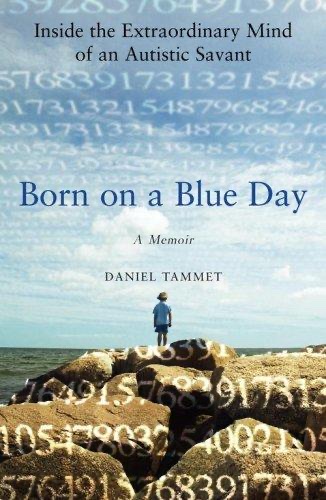
Cover of Born on a Blue Day

Born on a Blue Day

Daniel Tammet

4 ideas

  1. Reciting Pi to 22,514 Digits

    On 14 March 2004, at Oxford's Museum of the History of Science, Tammet recited pi from memory to 22,514 decimal places in just over five hours without error, setting a European record and raising money for the National Society for Epilepsy. He had no drills of rote repetition; he learned the digits as a continuous visual landscape of coloured, textured number-shapes and recited by walking through that scenery. The episode shows extreme memory achieved by encoding abstract data as meaningful sensory structure rather than as arbitrary symbols.

  2. Calculation Through Synaesthetic Number Shapes

    Tammet describes numbers up to 10,000 as having their own shapes, colours and textures, with some also carrying emotional qualities. When he multiplies, he sees the two numbers' shapes and a third shape forms between them that he recognizes as the answer; division he describes differently, as spiralling shapes. He presents this as seeing results rather than working them out step by step.

  3. Routine and Counting Contain Sensory Overwhelm

    Tammet describes rigid routines, such as the same breakfast weighed to the gram, fixed daily schedules, and counting objects, as tools rather than symptoms: they make an unpredictable, overstimulating world predictable enough to function in. When the order is disrupted, anxiety spikes, so the compulsion to structure is a self-regulation strategy that others often misread as mere stubbornness.

  4. Savant Ability Linked to Ordinary Association

    Tammet ties his synaesthetic experience of numbers and words to the associative thinking everyone uses, such as ordinary metaphor, rather than treating it as inexplicable magic. On this view his abilities differ from typical cognition in degree and wiring, not in kind.

Save and mark ideas in the app