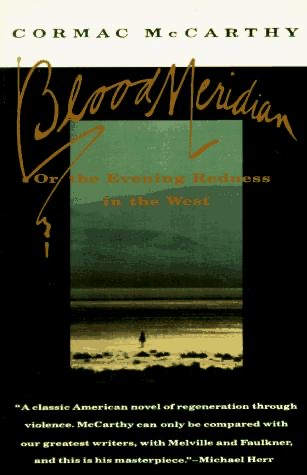
Cover of Blood Meridian

Blood Meridian

Cormac McCarthy

4 ideas

  1. Glanton gang's state-sponsored scalp-hunting contract

    In 1849, the Mexican state of Chihuahua paid bounties for Apache scalps. John Joel Glanton's gang of American mercenaries, which the kid joins, took the contract and soon began killing peaceful Tigua villagers and Mexican citizens, because their hair could not be told apart from Apache hair at the point of payment. The gang was destroyed at the Yuma ferry crossing, and that episode shows how a bounty that pays for a proxy of the target (hair) instead of the target itself turns the contractor against the people who hired it.

  2. Holden's claim that war is god

    Judge Holden argues that war is the ultimate game because its wager includes the players' own existence, so it forces a verdict of one will over another. He calls moral law an invention of mankind to strip the powerful of their advantage in favor of the weak, and says historical law overturns it at every turn. For Holden, war was not displaced by civilization: it waited for man before man existed, the ultimate trade awaiting its ultimate practitioner.

  3. The suzerain: dominion through total knowledge

    The Judge sketches the birds, plants and artifacts he finds in his notebook and then destroys the originals. He says that whatever exists without his knowledge exists without his consent, and he wants to be 'suzerain' of the earth. On this view, cataloguing something is a way of taking ownership of it: whatever has been named and recorded can be controlled or erased, and whatever escapes the record is a threat to sovereignty.

  4. Optical democracy: humans as mere landscape

    The narrator describes the desert as a place where every object, a rock, a lizard or a man, receives equal light and equal weight, and none of them has any claim to precedence. Reading violence this way takes humans out of the moral center and shows them as one more phenomenon in an indifferent landscape. Atrocity is recorded with the same flat attention as weather, and the reader is left to supply whatever moral judgment the world itself refuses to give.

Save and mark ideas in the app