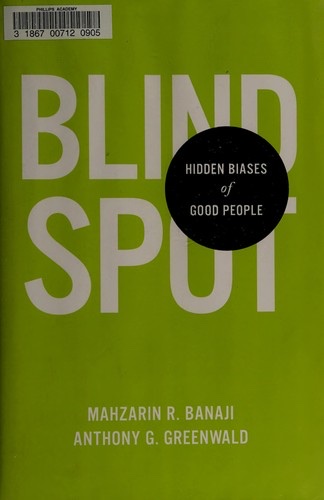
Cover of Blindspot

Blindspot

Mahzarin Banaji and Anthony Greenwald

5 ideas

  1. Mindbugs: systematic errors of automatic cognition

    Mindbugs are ingrained habits of thought that produce errors in how we perceive, remember, and judge, analogous to visual illusions that persist even after you know they are illusions. Because they operate below awareness, knowing about a mindbug does not switch it off, and it quietly shapes judgments about people who belong to social groups.

  2. Measuring associations through sorting speed

    The Implicit Association Test asks people to sort words and images using shared response keys, and it infers the strength of an association from how much faster sorting is when paired categories match existing mental links (e.g., 'young + good') than when they conflict ('old + good'). The difference in speed stands in for an association the person may not report or even know they hold.

  3. The researcher who failed her own test

    Banaji, an Indian-born woman who studies prejudice and holds egalitarian values, took the race IAT she had helped create and found that she paired white faces with 'good' more quickly than Black faces. Repeated attempts gave the same result, which showed her that sincere beliefs and expertise do not protect a person from absorbing the associations of their culture.

  4. Reflective and automatic attitudes can diverge

    People can sincerely endorse equality while holding automatic associations that favor dominant groups, so self-reported attitudes and implicit measures capture different things. The authors call this dissociation between what the reflective mind believes and what the automatic mind has learned a blindspot, not hypocrisy.

  5. Discrimination often works through in-group favoritism

    The authors argue that much modern discrimination comes less from hostility toward outgroups than from small, routine acts of helping one's own group, such as referrals, benefit of the doubt, and informal favors. Because each act feels like kindness rather than bias, the cumulative disadvantage it creates for outsiders goes unnoticed.

Save and mark ideas in the app