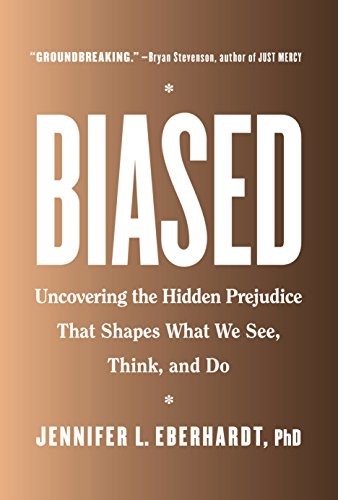
Cover of Biased

Biased

Jennifer Eberhardt

5 ideas

  1. Bias flows both ways between race and crime

    The association between Black people and crime is bidirectional: priming people with Black faces speeds their detection of crime-related objects, and priming them with crime-related images draws their visual attention toward Black faces. Because the link runs in both directions, thinking about crime directs attention to Black people, and seeing Black people brings crime to mind. Neither step requires conscious prejudice.

  2. Other-race effect in face recognition

    People recognise faces of their own race more accurately than faces of other races because the brain tunes its face-processing to the faces it sees most. This perceptual narrowing is a matter of exposure, not intent. It produces real harms, such as eyewitness misidentification across racial lines, and it can be reduced with experience and with training that tells people to attend to individuating features.

  3. Slowing decisions to curb bias

    Bias is most likely to drive behaviour when decisions are fast, ambiguous, and made under stress, because those are the conditions in which quick associations stand in for deliberate judgment. Adding friction to high-discretion decision points reduces biased outcomes. Examples include requiring an officer to state a specific reason for a stop, or adding a prompt before users flag a 'suspicious' neighbour.

  4. Stereotypical Black features raise death-sentence odds

    In death-eligible cases with white victims, defendants judged to look more stereotypically Black were significantly more likely to be sentenced to death than defendants who looked less stereotypical. Punishment tracks how strongly a face fits the racial stereotype, not only the defendant's race category. This shows bias working along a gradient of perceived features.

  5. Bias as condition, not character flaw

    Implicit bias is better understood as a product of how the brain categorises and of the patterns a culture repeatedly shows, not as a sign of bad character. Seeing it this way moves the focus from blaming individuals to redesigning situations, exposures, and institutions. It also means good intentions and diverse identity do not protect anyone, because bias can operate even in people who sincerely reject racism, including members of the targeted group.

Save and mark ideas in the app