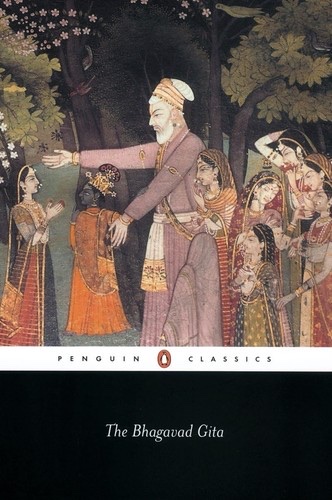
Cover of Bhagavad Gita

Bhagavad Gita

Anonymous

10 ideas

  1. The warrior who drops his bow

    Seeing teachers, cousins and elders on the opposing side, Arjuna is overcome with grief, sets down his bow and refuses to fight. He argues that killing kin is a sin, that it would destroy family duties and lead to social collapse, and that nothing won this way would be worth having. Krishna answers these arguments, and his answer makes up the rest of the dialogue.

  2. Right to action, never to fruits

    You have authority over what you do but no claim on what comes of it, so your effort should not be tied to the payoff. Outcomes depend on many forces beyond the actor. Making them the reason you act leaves you anxious when things go well and broken when they don't.

  3. Abstaining from work is not freedom

    The Gita holds that freedom from action is not reached by simply refraining from work, since no one can stay entirely actionless even for a moment. Renouncing outward activity does not by itself free a person from action. Krishna therefore urges Arjuna to do his work rather than withdraw from it.

  4. Svadharma: one's own duty

    Each person has a duty set by their role and nature. Doing your own duty imperfectly is better than doing someone else's well. Arjuna's duty as a warrior is to fight a just war, and dropping it to take up a renunciant's ideal is a failure, not a virtue.

  5. The self neither kills nor dies

    The true self is eternal and cannot be destroyed. It passes through bodies the way a person changes clothes. So grief over killing or being killed misreads what actually ends. Death changes the form, not the essence.

  6. Three gunas as motive diagnostics

    Every action, food, gift and form of knowledge can be sorted by three qualities. Sattva is clarity and balance, rajas is restless craving and activity, and tamas is inertia and delusion. Asking which quality drives a choice shows its real motive, whatever story you tell yourself about it.

  7. Equanimity as the test of wisdom

    The wise person is steady in wisdom: unmoved by pleasure and pain, gain and loss, praise and blame. They pull in the senses like a tortoise pulls in its limbs. Wisdom shows up as an even mind under pressure, not as what a person knows.

  8. Three paths: action, knowledge, devotion

    There are three routes to liberation. Karma yoga is selfless work, jnana yoga is discerning the self from what is not the self, and bhakti yoga is loving surrender to the divine. The paths fit different temperaments but lead to the same place, and devotion is presented as the most accessible.

  9. Desire cascades into ruin

    Dwelling on objects of the senses breeds attachment, and attachment breeds desire. Frustrated desire becomes anger, anger clouds judgment, and clouded judgment erodes memory and reason until the person is lost. The chain starts with where attention rests.

  10. Arjuna as Krishna's instrument

    In the cosmic vision, Krishna names himself as the destroyer and says the warriors facing Arjuna are already slain by him. He tells Arjuna to be merely the instrument and to fight. Arjuna is still asked to act fully, but within an outcome Krishna presents as already set.

Save and mark ideas in the app