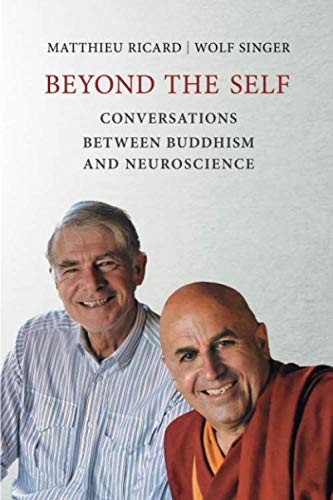
Cover of Beyond the Self

Beyond the Self

Matthieu Ricard and Wolf Singer

4 ideas

  1. Pure awareness beneath mental content

    Ricard argues that consciousness has a basic luminous quality, bare knowing, that stays present whether or not thoughts and emotions occupy it, much as a mirror stays itself whatever it reflects. Meditation trains the practitioner to recognize this knowing directly, so that thoughts are experienced as passing events inside awareness rather than as the self. Singer questions whether a state with no content can be verified at all, or whether it is just another, subtler neural representation.

  2. Emotions are trainable skills, not fixed traits

    Traits such as compassion, attention, and emotional balance can be cultivated through sustained practice, the way reading or a musical instrument is learned. Repeated mental exercise changes the brain structurally and functionally through neuroplasticity. Temperament is therefore a starting point rather than a destiny, and practice over months and years can shift a person's baseline.

  3. First-person and third-person knowledge as complementary

    Introspection by trained contemplatives and measurement by neuroscientists are treated as two instruments aimed at the same phenomenon, each blind where the other sees. Expert meditators can report on mental states with the precision needed to guide what scientists measure, and brain data can check or refine what introspection claims. Neither route alone can close the gap between subjective experience and neural mechanism.

  4. Gamma synchrony in long-term meditators

    EEG studies of practitioners with tens of thousands of hours of meditation found unusually high-amplitude gamma-band oscillations during compassion meditation. Singer links this synchronized neural activity to the binding of distributed processes into coherent states. The finding is offered as evidence that contemplative training can produce measurable brain states that untrained people do not show.

Save and mark ideas in the app