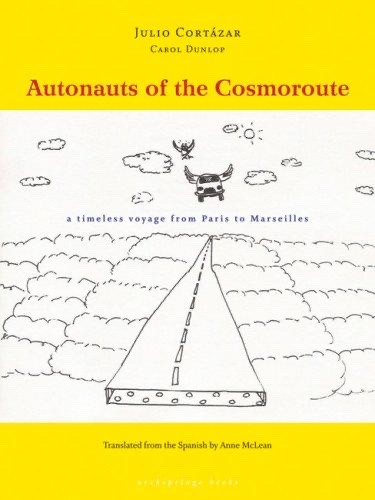
Cover of Autonauts of the Cosmoroute

Autonauts of the Cosmoroute

Julio Cortázar and Carol Dunlop

4 ideas

  1. Thirty-three days on the Paris–Marseille autoroute

    In May–June 1982 Julio Cortázar and Carol Dunlop drove a Volkswagen camper named Fafner from Paris to Marseille. Their self-imposed rule was to stop at two rest areas per day, sleep at the second, and never leave the autoroute, which turned a trip of a few hours into more than a month. Dunlop died later that year, and Cortázar finished the book alone, so the playful log became an elegy for the journey and for her.

  2. Arbitrary rules as engines of perception

    Following a strict, deliberately pointless rule, such as two stops a day with no exits, forces attention onto what ordinary goal-driven movement skips. Because the rule removes the destination as the point, the in-between spaces become the whole field of experience and must be fully inhabited. The constraint works like a game's rules: it is arbitrary on purpose, and that arbitrariness is what generates meaning and discovery.

  3. Transit spaces as an unexplored country

    Places designed only to be passed through, like rest areas, parking lots, and service stations, can be treated as a territory with their own inhabitants, customs, flora, and dangers. Documenting them with the solemnity of an explorer, through logs, inventories, and observations, exposes a world that exists in plain sight but has never been looked at. Non-places become places once someone chooses to stay in them.

  4. Mock-scientific form as intimate disguise

    The book is written as a parody expedition report, with daily logs, lists of provisions, and 'scientific' observations, and the two travelers appear under nicknames as the Wolf and the Bear. The pseudo-objective apparatus gives a love story and private happiness a form that can be shared without sentimentality. The play frames the tenderness, and the tenderness in turn makes the play moving.

Save and mark ideas in the app