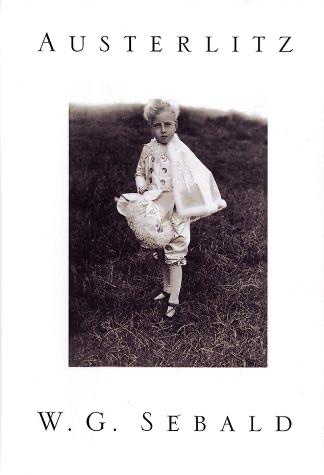
Cover of Austerlitz

Austerlitz

W. G. Sebald

4 ideas

  1. Austerlitz reconstructs his erased Kindertransport childhood

    Raised in Bala, Wales, as Dafydd Elias by a Calvinist preacher and his wife, Austerlitz learns his real name as a teenager and, decades later, after a breakdown, travels to Prague, where his old nursemaid Věra tells him his mother Agáta, an actress, was deported to Theresienstadt and his father Maximilian fled to Paris. He slows a Nazi propaganda film of the camp to search its faces for his mother and thinks he sees her, but Věra rejects that face and instead recognizes Agáta in a theatrical photograph from the Prague archives.

  2. Fortifications outmoded by their own escalation

    Austerlitz argues that fortress design escalated as each defense answered the last threat, so ever more elaborate works took longer to build and were often obsolete by completion as warfare changed. The novel's fortresses, including crab-shaped Breendonk and star-shaped Theresienstadt, ended up as prison and camp rather than as defenses.

  3. Self-imposed ignorance as a delayed psychic collapse

    Austerlitz shields himself by refusing to learn anything about pre-war Europe, the Nazi period, or his origins, even avoiding newspapers and certain histories. The suppressed knowledge does not disappear. It resurfaces as insomnia, loss of language, and a breakdown in middle age, so that avoidance only postpones the reckoning and makes it more violent.

  4. Buildings as palimpsests concealing prior atrocities

    New institutions are often built directly over sites of violence and erase them. The novel's example is the new Bibliothèque nationale in Paris, which stands on the ground of a depot where property looted from deported Jews was sorted and stored. Reading a place this way means asking what the site held before, which turns stations, archives and libraries into evidence of what they were built to forget.

Save and mark ideas in the app