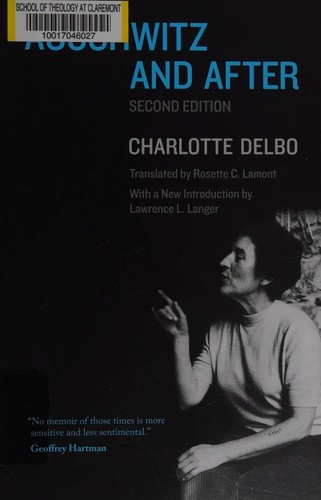
Cover of Auschwitz and After

Auschwitz and After

Charlotte Delbo

4 ideas

  1. Deep memory and ordinary memory

    In the passage from Days and Memory that Langer's introduction quotes, Delbo distinguishes an ordinary, intellectual memory that can put Auschwitz into words from a deep memory that holds it as bodily sensation. She says the camp self is enclosed in a skin of memory that, unlike a snake's discarded skin, is not shed but persists. In dreams that skin gives way, and she suffers the camp again rather than recalling it.

  2. The January 1943 convoy of 230

    In January 1943 Delbo was deported to Auschwitz-Birkenau with 230 French women, mostly résistantes and political prisoners, after the Germans had shot her husband Georges Dudach. The camp killed the convoy through typhus, dysentery, beatings, hours-long roll calls in the snow, and gassing, and only 49 women returned. Those who survived had kept one another alive: holding each other up at roll call, sharing water, and refusing to let a comrade lie down in the snow.

  3. Knowledge of death as useless knowledge

    Delbo calls what Auschwitz taught 'useless knowledge': knowing death and the devastation of human beings from the inside. Such knowledge has no use in the life she returns to, and the book presents it as something the survivor carries back with her.

  4. Testimony demands seeing, not understanding

    Delbo writes in fragments, prose poems, and direct address to the reader: 'O you who know,' 'try to look, just try and see.' She withholds explanatory narrative because causal storytelling turns atrocity into something digestible. The reader is made to witness isolated, unassimilable images rather than grasp them, which shows the gap between knowing about suffering and seeing it.

Save and mark ideas in the app