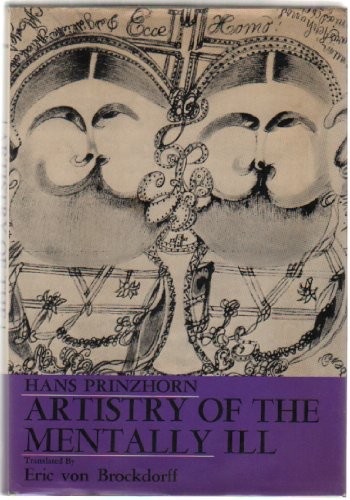
Cover of Artistry of the Mentally Ill

Artistry of the Mentally Ill

Hans Prinzhorn

5 ideas

  1. The urge to configure (Gestaltungsdrang)

    Prinzhorn posits a universal psychic drive to give form to experience, independent of skill, training, or intent to make 'art'. This drive underlies all image-making, so the pictures of untrained asylum patients express the same basic human tendency as professional art, only with fewer cultural constraints on it.

  2. Six component drives of image-making

    The configurative urge breaks down into related tendencies. These are the expressive need, the play drive, the ornamental urge to decorate surfaces, the ordering tendency toward rhythm and symmetry, the imitative tendency to copy reality, and the need for symbols that carry meaning. Any picture can be analysed by which of these dominates. In schizophrenic work, ordering and symbolic tendencies often override imitation entirely.

  3. Judge form, not diagnosis

    Prinzhorn treats patients' works mainly as configurations to be read for their formal qualities, not as symptoms that confirm a clinical label. This shift makes visible the intensity, invention, and coherence that a purely pathological reading hides. The same object stops being evidence of defect and becomes an achievement of form.

  4. Autistic isolation produces uncanny, self-referential art

    The quality that most sets schizophrenic art apart is not lack of skill. It is its closed, autistic character: the forms answer to a private world and ignore any viewer or shared convention. This produces a disquieting strangeness, with dense filling of space, merged figures, and invented script, that no amount of technical deficiency can explain.

  5. Madness and modernism share formal kinship

    Prinzhorn observes that patients' works resemble contemporary Expressionist art, and also children's and 'primitive' art, in their distortion, abstraction, and rejection of naturalism. He argues that this resemblance comes from a shared turn inward toward an inner vision, not from shared pathology. This complicates both dismissals of modern art as 'insane' and romantic claims that madness equals genius.

Save and mark ideas in the app