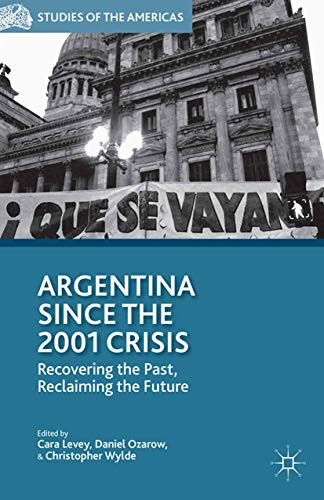
Cover of Argentina Since the 2001 Crisis

Argentina Since the 2001 Crisis

Cara Levey, Daniel Ozarow and Christopher Wylde, editors

4 ideas

  1. December 2001: Argentina's collapse and revolt

    In December 2001 the government froze bank withdrawals (the 'corralito') while unemployment was already high. Mass looting, pot-banging 'cacerolazos' and street battles on 19–20 December, under the chant '¡Que se vayan todos!' ('They all must go!'), forced President Fernando de la Rúa to flee the Casa Rosada by helicopter, and dozens of people were killed. Argentina then went through five presidents in about two weeks, declared the largest sovereign default in history up to that point, and saw neighbourhood assemblies, piquetero unemployed movements and worker-recovered factories spread as forms of self-organisation.

  2. The commodities consensus behind neo-extractivism

    Latin American governments of left and right converged on financing growth and social spending through large-scale export of primary goods such as soy, minerals and hydrocarbons during the global price boom. The consensus is political as well as economic. Redistributive progressive governments made their welfare gains depend on expanding extraction, and this displaced the environmental and territorial costs onto rural and indigenous communities while treating critics as enemies of development.

  3. Kirchnerism rebuilt governability partly through cooption

    After 2003, Kirchnerism restored state authority in part by taking up protesters' demands and drawing some movement leaders and organisations into the state through welfare programmes, jobs and alliances, while isolating groups that refused. The book treats this cooption as real but partial: contributors such as Dinerstein and Schaumberg show resistance and horizontal organisation continuing alongside it.

  4. Middle class as contested political identity

    The book treats Argentine 'middle class' as a cultural and political self-identification rather than simply an income band. Aguiló shows it being defended through implicit markers of whiteness and European descent, which helps explain why impoverished 'new poor' households held on to middle-class allegiances after 2001. Svampa, however, describes both pro-Kirchnerist and opposition middle-class sectors, so the identity is not uniformly anti-Peronist.

Save and mark ideas in the app