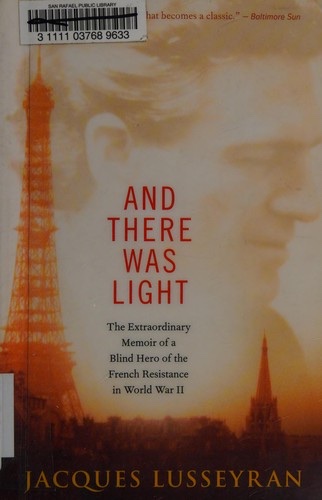
Cover of And There Was Light

And There Was Light

Jacques Lusseyran

4 ideas

  1. Blind Teenager Vets Recruits for Resistance

    Jacques Lusseyran was blinded at about eight in a Paris schoolroom accident. At seventeen, in 1941, he co-founded the student Resistance group Volontaires de la Liberté and interviewed recruits himself, judging their trustworthiness by voice rather than by sight. He was later arrested after an informer betrayed the group and was deported to Buchenwald, where he was among the few of his convoy to survive.

  2. Inner Light Governed by Emotional State

    After losing his sight, Lusseyran perceived a luminous inner field that let him sense objects and space. That light narrowed or went dark whenever he felt fear, anger, jealousy, or impatience, and he would then collide with things. Calm, attentive openness restored it, so his perception depended directly on his moral and emotional posture.

  3. Blindness as Attention Without Surfaces

    Losing sight removes the eye's habit of skimming the visible surfaces of things. Attention is then forced toward presences, pressures, textures, and the quality of sounds and voices. What looks like deprivation becomes a retraining of attention that reveals layers of the world sighted people routinely overlook.

  4. Fear, Not Hardship, Destroys Prisoners

    In Buchenwald, Lusseyran observed that prisoners who surrendered to fear and self-pity wasted away faster than their physical conditions alone explained. After nearly dying of illness, he found an inner joy that did not depend on circumstances. That joy sustained him and made him a source of strength for fellow inmates, which led him to argue that an inner orientation can determine survival.

Save and mark ideas in the app