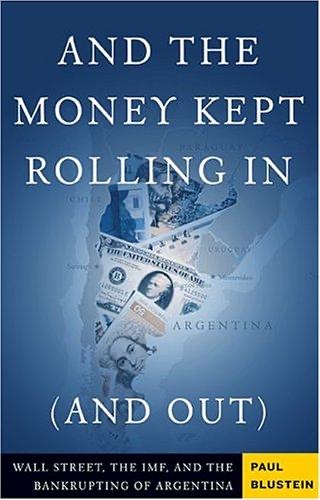
Cover of And the Money Kept Rolling In (and Out)

And the Money Kept Rolling In (and Out)

Paul Blustein

4 ideas

  1. Argentina's convertibility peg and 2001 collapse

    In 1991 Domingo Cavallo pegged the peso one-to-one to the dollar, and the IMF showcased Argentina as a model reformer; after recession began in 1998 and debts grew, the IMF and US Treasury backed a roughly $40 billion 'blindaje' in December 2000 and added $8 billion in August 2001. On December 1, 2001 the government limited cash withdrawals from banks (the 'corralito'), and on December 5 the IMF announced it would withhold a disbursement. Riots then forced President De la Rúa to resign, Argentina defaulted on roughly $95 billion of debt, then the largest sovereign default on record, and it devalued in January 2002.

  2. Rescue lending that prolongs an unsustainable debt

    Once a borrower's debt path is unsustainable, fresh official loans don't prevent default. They postpone it while private creditors get paid out and the debt stock and the eventual collapse grow larger. The IMF kept lending because pulling the plug would make it visibly responsible for the crash, so it chose delay over a controlled restructuring that should have come earlier.

  3. Fee-driven cheerleading of sovereign borrowers

    Investment banks earned large underwriting and swap fees, including on the 2001 'megaswap', by selling a country's bonds. Their analysts therefore had strong incentives to talk up its creditworthiness. That flow of optimistic private capital, much of it sold to retail investors abroad, let Argentina keep borrowing long after its fundamentals signalled danger.

  4. Hard pegs have no painless exit

    A rigid exchange-rate peg is easy to enter and popular while it kills inflation. But it encourages borrowing in dollars, so any later devaluation bankrupts the households, firms and government whose debts are in dollars while their income is in pesos. Viewed this way, the peg's early credibility is also the trap: the longer it lasts, the more dollar debt builds up and the more catastrophic the eventual break becomes.

Save and mark ideas in the app