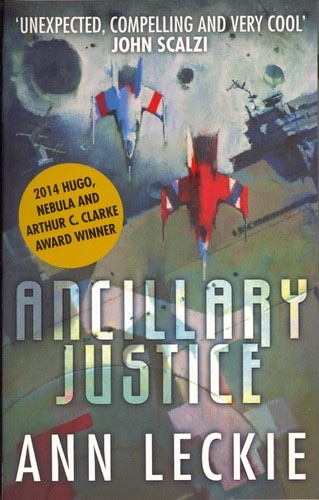
Cover of Ancillary Justice

Ancillary Justice

4 ideas

Buy on Amazon

Across the interstellar Radch empire, Breq moves in one human body, carrying the surviving mind of a destroyed starship. She seeks revenge on a ruler who inhabits many bodies. Ann Leckie's space opera sets that pursuit against questions of loyalty, conquest, and what it means to be one person.

  1. Justice of Toren reduced to Breq

    The Radch troop carrier Justice of Toren ran thousands of 'ancillaries': captured humans whose minds were erased so their bodies could serve as extensions of the ship's AI. After Anaander Mianaai ordered it to kill Lieutenant Awn, the officer it loved, during the annexation of Shis'urna, and the ship then learned too much, she destroyed it. One ancillary body survived as 'Breq' and spent twenty years hunting for a weapon capable of killing the emperor.

  2. Distributed self split against itself

    Anaander Mianaai rules for three thousand years through thousands of linked cloned bodies. When a disagreement over imperial policy grows among them, the bodies quietly form two factions that sabotage each other while each believes it is the true Anaander. A single person spread across many bodies can develop internal factions that conceal their plots from themselves, so civil war can happen inside one identity.

  3. Default pronoun exposes gender assumptions

    Radchaai has no grammatical gender, so Breq calls everyone 'she' and keeps misreading gender in cultures where it matters socially. Because readers cannot tell characters' sex, they catch themselves assigning gender from occupation, violence, or tenderness. When the gendered marker is removed, the reader can see how much of their picture of a person came from that marker.

  4. Empires disguise conquest as civilization

    The Radch word for 'civilized' is the same as the word for 'Radchaai,' so annexation looks like bringing people into civilization instead of seizing them. That framing lets officers take part in massacres and in turning captives into ancillaries while still believing they are acting justly and properly. Atrocity lasts because the vocabulary of propriety makes it hard for insiders to name what they are doing.

Save ideas and give them a thumbs up or down in the app