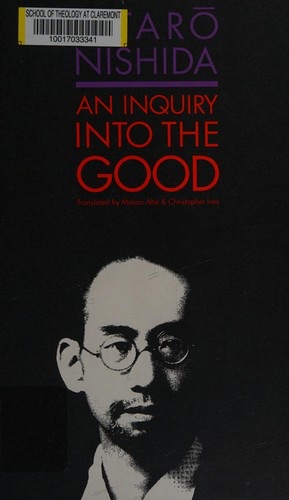
Cover of An Inquiry into the Good

An Inquiry into the Good

Nishida Kitarō

6 ideas

  1. Pure experience precedes subject and object

    Pure experience is experience as it is, before any thinking adds a judgment like 'I am hearing a sound' or 'this is a color.' At that moment there is no knower standing apart from a known thing; the split into subject and object comes afterward, when reflection breaks up a unified field of experience. So the self is not something that has experiences. The self is a later abstraction made out of experience.

  2. The climber absorbed in the cliff

    Nishida describes a climber scaling a cliff with total effort and a musician playing a piece he has fully mastered. In both cases, attention is so complete that no gap remains between self and activity; the person is the act of climbing or playing. These cases show that pure experience is not rare or mystical. It happens whenever consciousness works at full unity, and it vanishes the moment the person steps back to reflect on what they are doing.

  3. Reality is one self-unfolding system

    Nishida argues that reality is not mind plus matter but a single activity that differentiates itself and then reunifies at a higher level. Opposition and contradiction are how this system develops, not failures within it. What we call 'nature' is this activity seen with the unifying self left out. What we call 'spirit' is the same activity seen with the unifying function brought into view.

  4. The good is realizing your personality

    On Nishida's ethics, the good is neither pleasure nor obeying an external rule. It is the self-realization of personality, meaning the unifying power of consciousness developing fully. An act is good when it comes from the deepest demand of the whole self rather than from partial desires. At its fullest, such an act merges with the unifying force of reality itself.

  5. Knowledge and love as one act

    To know a thing truly is to become one with it by dropping your own vantage point, and that same self-forgetting union is love. Seen this way, understanding is not detached observation. It is sympathetic merging, the way a parent knows a child or a scholar comes to know a subject by losing themselves in it. Deeper knowledge and deeper love turn out to be the same movement toward unity.

  6. Religion as the self returning to its source

    Nishida defines religion as the self's recognition that its own unifying activity is continuous with the unity at the ground of reality, which he calls God. It is not a belief in an outside being who hands out rewards. Religious feeling arises when the small self is negated and one discovers that one's deepest life is the universe's own life. On this view religion is the completion of knowledge and ethics rather than a separate area of life.

Save and mark ideas in the app