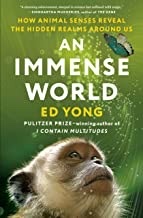
Cover of An Immense World

An Immense World

Ed Yong

5 ideas

  1. The Umwelt as a species' perceptual bubble

    Each animal lives inside an Umwelt, a sensory world built from only the slice of the environment its senses can detect. The tick's world, for example, reduces to butyric acid, warmth, and hair. Sharing one physical environment does not mean sharing one world, because each species picks up and ignores different signals.

  2. Sensory pollution as an invisible habitat loss

    Artificial light, anthropogenic noise, and electromagnetic interference change what animals can detect even when their physical habitat stays intact. Streetlights lure sea-turtle hatchlings away from the ocean, and shipping noise shrinks the range over which whales can communicate. Conservation therefore has to protect sensory spaces, like quiet and darkness, and not only land and water.

  3. Senses shaped toward what matters to each animal

    Evolution shapes each animal's sensory systems toward the information relevant to its way of life. What an animal senses therefore reflects its needs rather than a complete picture of its surroundings.

  4. Mantis shrimp's many photoreceptors, poor colour discrimination

    Mantis shrimp have 12 to 16 photoreceptor types, compared with three in humans, which suggested extraordinary colour vision. Experiments showed they actually discriminate similar colours worse than humans do. They appear to use their receptors for fast, direct recognition of colours without comparing signals, which shows that more sensors can mean a different processing strategy rather than richer perception.

  5. Ask what sensing is like, not how well

    Ranking animals by acuity misses the point. The more revealing question is what it is like to perceive through that sense, since a dog's world is organised around smell, which carries information about time and history that vision cannot. Imagining another creature's experience requires deliberately setting aside the human bias toward vision.

Save and mark ideas in the app