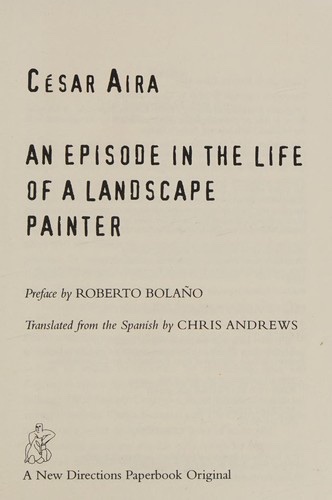
Cover of An Episode in the Life of a Landscape Painter

An Episode in the Life of a Landscape Painter

César Aira

4 ideas

  1. Rugendas struck by lightning on pampas

    In the 1830s the German painter Johann Moritz Rugendas crosses the Argentine pampas with his companion Robert Krause to capture the landscape, and he and his horse are struck by lightning. His foot is caught in the stirrup and the horse drags him across the ground, leaving his face grotesquely disfigured and his nerves wrecked. Dosed with morphine and hiding his face behind a black lace veil, he still insists on continuing toward the frontier to witness and sketch an Indian raid.

  2. Physiognomy of nature as artistic method

    Following Humboldt, Rugendas treats landscape painting as a scientific instrument. The painter selects the characteristic forms of a region (its vegetation, relief, light and inhabitants) so that a single picture conveys the total 'physiognomy' of a place. The artist's task becomes knowledge-gathering: the image is meant to let a distant viewer grasp the whole of a place they have never seen.

  3. Catastrophe redirects rather than ends vocation

    The lightning strike does not stop Rugendas's project. It becomes the event that drives the remaining narrative and his art. Pain, drugs and the veil now filter everything he sees, so his perception is altered at the very moment he pursues his most intense subject. The accident produces a new mode of seeing, and his commitment to the work becomes almost compulsive.

  4. The observer becomes the spectacle

    The painter who set out to render the exotic for European eyes is himself turned into a monstrous, veiled figure that others stare at. This undoes the tidy line between the detached observer and the observed scene. The pursuit of an objective record draws the recorder bodily into what he records, and in the process makes him strange.

Save and mark ideas in the app