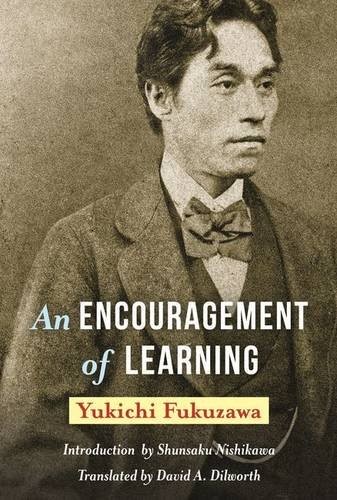
Cover of An Encouragement of Learning

An Encouragement of Learning

Fukuzawa Yukichi

5 ideas

  1. Equal birth, unequal learning explains inequality

    Heaven creates no person above or below another, so gaps in wealth, rank and power come from differences in learning, not birth. Someone who studies useful things and understands affairs becomes noble and rich, and someone who does not becomes poor and low. Status is therefore something you earn through study rather than inherit.

  2. Practical learning before ornamental scholarship

    Fukuzawa gives priority to jitsugaku, practical knowledge close to daily use, such as reading and writing, letters, bookkeeping, the abacus, weights and measures, geography, physics, history, economics and ethics. He allows that classical poetry and literature bring pleasure and have value, but holds they should come after practical learning, since scholarship that leaves a person unable to manage a household or business misses the main point. The measure of learning is whether it helps one run one's own affairs.

  3. Personal independence precedes national independence

    A nation can only be independent if its individual people are independent, because people who depend on others for their judgment and livelihood will not defend the country as their own affair. A population that leaves everything to the government is a nation of spectators and guests, so it will fold before foreign pressure. For this reason, capable people should build private enterprise and self-reliance rather than seek government posts.

  4. Citizen as both guest and host

    Each citizen holds two roles at once. As a guest, the citizen owes obedience to laws made by the government. As host, the citizen has contracted with the government by paying taxes in exchange for protection. When a law is unjust, a citizen who breaks it violently fails the guest duty, and one who silently submits fails the host duty, so the right course is to persist in reasoned protest and accept the consequences.

  5. Sakura Sogoro versus the faithful servant

    Fukuzawa presents Sakura Sogoro, a village headman said to have petitioned the shogun over his lord's head against unjust taxes and been executed for it, as a model of dying for right through protest, while noting that the story rests on popular tradition without verified historical evidence. He compares deaths in loyal suicide or vendetta to a servant hanging himself over a lost errand coin, saying such deaths add nothing to civilization. The comparison drew heavy criticism, and Kusunoki Masashige is named only in his later defense of it.

Save and mark ideas in the app