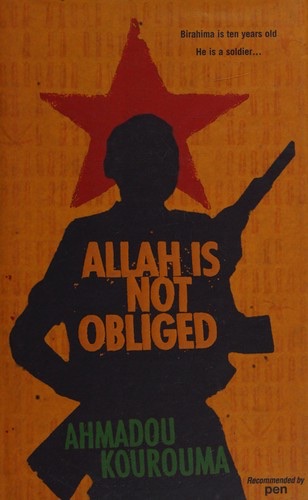
Cover of Allah Is Not Obliged

Allah Is Not Obliged

Ahmadou Kourouma

4 ideas

  1. Birahima's journey from Togobala to warlord camps

    Birahima, a boy of about ten or twelve from Togobala in northern Côte d'Ivoire, is orphaned when his mother dies of an ulcerated leg. He sets out for Liberia with Yacouba, a charm-maker and con man, to find his aunt Mahan. He ends up as a small soldier with a Kalashnikov, passed between rival factions in Liberia and Sierra Leone, including Taylor's NPFL, ULIMO, Prince Johnson and Foday Sankoh's RUF. The aunt turns out to be dead, and he tells the whole story to his cousin, a doctor who takes him in, and that telling is the novel itself.

  2. The gun substitutes for family and food

    Children join warlord factions less out of ideology than because the Kalashnikov offers what their destroyed families and states no longer give: food, protection, status and a surrogate kin group. The factions exploit this by paying in drugs, loot and the right to kill. As a result, recruitment runs on material abandonment, not on persuasion.

  3. Funeral orations as ledgers of atrocity

    Each time a fellow child soldier dies, Birahima delivers a mock funeral oration that recounts how that child came to the war. The stories include murdered parents, abuse and hunger, and each child becomes both a victim and a killer. Together, the eulogies show that every perpetrator was first a casualty, so the story refuses both innocence and pure blame.

  4. Humanitarian and religious language masking plunder

    The warlords speak of liberation, democracy, Islam, Christianity and protective fetishes while running diamond, gold and looting economies. Birahima's flat, dictionary-checked narration puts the official vocabulary next to the concrete act, which exposes the gap between stated cause and actual mechanism.

Save and mark ideas in the app