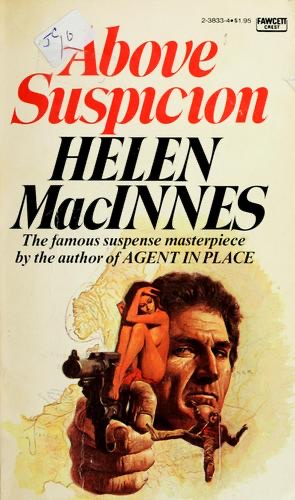
Cover of Above Suspicion

Above Suspicion

Helen MacInnes

4 ideas

  1. Oxford honeymooners trace a vanished agent

    In summer 1939 Richard Myles, a young Oxford don, and his wife Frances are asked to use their Continental holiday to find a British agent who has gone silent in the Reich. They follow a chain of contacts across Paris, Germany and into the Austrian Tyrol, each one passing them on through prearranged signals, until their cover collapses and they must escape Gestapo pursuit. The plot draws on MacInnes's own travels through 1930s Europe with her husband, and it serves as a case study of how quickly ordinary tourists become targets under a police state.

  2. Innocence as the operative's best cover

    The couple are recruited because they are genuinely what they appear to be: a naive, harmless academic pair on holiday with no training and no record. The cover is valuable because it is not a performance, and it holds only while they keep behaving like tourists.

  3. Chain-of-contacts with blind handoffs

    The search is built as a relay in which each contact knows only the next step, recognizes the couple by an agreed signal, and passes them on without seeing the whole route. This compartmentalization means a captured link cannot betray the full network. The cost is that the travellers move blind, cannot verify whom to trust, and an enemy who breaks one link can impersonate it.

  4. Tourist surface over totalitarian machinery

    The novel sets picturesque Germany and Austria, with their beer gardens, mountain villages and friendly hosts, against the surveillance, informers and brutality running just beneath them. Seeing both layers at once shows that an ordinary visitor's pleasant experience is itself something the regime manages. The lens also shows that the pleasant surface is part of how such a state disarms outside judgment in the months before war.

Save and mark ideas in the app