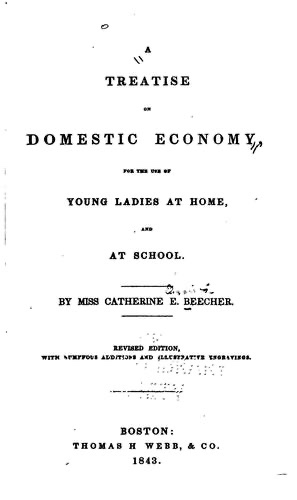
Cover of A Treatise on Domestic Economy

A Treatise on Domestic Economy

Catharine Beecher

3 ideas

  1. Housekeeping as a profession requiring training

    Beecher argues that running a household is a skilled occupation on a par with law or medicine, and that failures come from lack of instruction, not lack of character or effort. Because girls were given no systematic education in domestic management, she holds that it must be taught in schools as a formal subject with its own body of knowledge, which makes household competence a learnable skill rather than an inborn feminine trait.

  2. Planning time and money by priority

    Beecher advises the housekeeper to weigh her duties by relative importance, giving moral and religious obligations and the care of health a leading place, and to plan her time and expenditure so that pressing trivial demands do not crowd out weightier ones. She presents this as a flexible plan adapted to each family's circumstances rather than a fixed schedule, and recommends keeping written household accounts so the housekeeper can see where money actually goes and adjust.

  3. The home as democracy's foundational institution

    Beecher reframes domestic work as civic labor: in a democracy without hereditary classes, the character of citizens is formed in the family, so the woman who manages the home shapes the nation's moral and physical health. Seen this way, women's subordinate position in public life is a voluntary division of labor that gives them their own sphere of real influence, not a sign that they matter less. That framing raises housework from private drudgery to public duty while leaving the gender hierarchy intact.

Save and mark ideas in the app