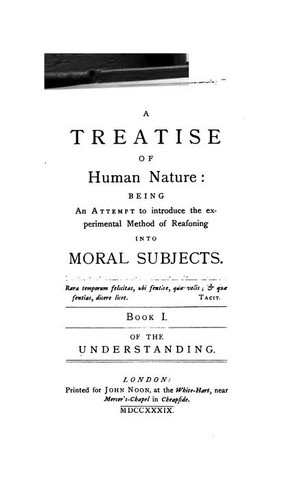
Cover of A Treatise of Human Nature

A Treatise of Human Nature

David Hume

6 ideas

  1. Causation is habit, not perceived necessity

    We never observe any power or necessary connection between a cause and its effect, only one event regularly followed by another. After enough repetitions, custom makes the mind expect the second event when it sees the first. That felt expectation is then projected onto the objects and mistaken for a necessity in the world.

  2. Reason is the slave of passions

    Reason alone can never move us to act. It only discovers relations of ideas and matters of fact. Every motive begins in a passion or desire, and reason's job is to find the means to ends the passions have already set, so a preference cannot be 'contrary to reason' in itself.

  3. The self as bundle of perceptions

    When I look inward for my 'self', I always stumble on some particular perception, such as heat, pain, or love, and never on a constant thing that has those perceptions. The mind is a rapid succession of perceptions tied together by resemblance and causation. The sense of one unchanging identity is a fiction built by the imagination sliding easily over closely related states.

  4. Impressions precede ideas: the copy principle

    Hume divides the mind's perceptions into impressions, which are vivid sensations and feelings, and ideas, which are fainter copies of them, and holds that simple ideas generally derive from corresponding prior impressions, while granting the missing shade of blue as a possible exception. Complex ideas can be assembled from simple ones without any matching whole impression. When a philosophical term seems doubtful, he asks which impressions its component ideas came from, as he does with necessary connection.

  5. Morality is felt, not reasoned out

    Look at a willful murder and you find passions, motives, and actions, but no fact of 'vice' until you turn to your own feeling of disapproval. Moral distinctions come from a moral sense or sentiment, not from reason's comparison of ideas. Calling something vicious means that contemplating it produces disapproval in a normal observer.

  6. The is-ought gap

    Moral writers routinely move from statements about what is to conclusions about what ought to be, without explaining how. 'Ought' expresses a new relation that cannot be deduced from factual premises alone. Any argument that slides from facts to obligations is hiding a missing step that needs its own justification.

Save and mark ideas in the app