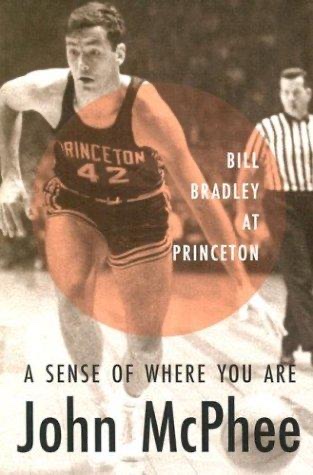
Cover of A Sense of Where You Are

A Sense of Where You Are

John McPhee

4 ideas

  1. Bradley's Final Four with Ivy League Princeton

    In 1965 Bill Bradley led Princeton, an Ivy League team with no athletic scholarships, to the NCAA Final Four. After losing the semifinal to Michigan, he scored 58 points against Wichita State in the third-place game, a Final Four scoring record. He was named the tournament's Most Outstanding Player even though his team did not reach the final. The case shows that one supremely prepared individual can lift a structurally outmatched team, and also where that ceiling lies.

  2. Internalized spatial awareness frees conscious attention

    Bradley could hook the ball over his shoulder without looking at the rim because years of repetition had built a bodily map of the court. He called this a sense of where you are. Once position no longer needs checking by sight, the eyes and mind are free for the moving, unpredictable parts of the game, such as teammates, defenders, and passing lanes. Mastery here means moving a skill below conscious attention so that attention can go to higher-order decisions.

  3. Self-imposed practice rules that remove crutches

    Bradley practiced alone for hours, and he did not leave a shooting spot until he had met a fixed quota of made shots. He dribbled while wearing glasses blocked at the bottom, so he could not look down at the ball. The method is to name the specific crutch that degrades performance under pressure, physically remove it in training, and set concrete completion rules rather than time-based ones. This turns fundamentals into automatic habits that hold up in chaotic game conditions.

  4. Basketball excellence within a larger life

    McPhee presents Bradley as an athlete who treated basketball with total rigor while keeping it one part of a life that also included serious academic and moral ambitions. Bradley chose Princeton, which offered no athletic scholarships, pursued his studies alongside the game, and accepted a Rhodes Scholarship to Oxford rather than going directly into professional basketball.

Save and mark ideas in the app