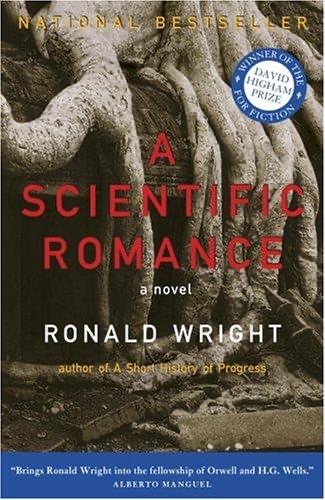
Cover of A Scientific Romance

A Scientific Romance

Ronald Wright

4 ideas

  1. Grieving curator rides Wells's machine forward

    In 1999 H.G. Wells's time machine reappears in London with a letter from Wells, and David Lambert, a museum curator grieving his lover's death from a prion disease that may also be killing him, takes it to the year 2500. He finds London drowned and overgrown in a hot, wet climate, England depopulated, and its survivors living as tribes. The episode is a concrete test case for whether modern civilisation's accumulated knowledge and institutions would outlast an ecological and epidemic collapse. The novel's answer is that they would not.

  2. Reading the present as future ruins

    Seeing one's own city through an archaeologist's eyes, as the stratum a later people will dig through, turns permanence into contingency. Institutions like the museum, the monument and the metropolis stop looking like fixed achievements and start looking like temporary deposits. Their survival depends on ecological conditions that can be withdrawn.

  3. Collapse comes from compounding self-inflicted shocks

    Civilisations are brought down less by a single catastrophe than by overlapping harms they created themselves. In the novel these are a warming, flooding climate and disease born of industrial practice, which together overwhelm the system's capacity to recover. The same technical success that built the society generates the forces that dismantle it.

  4. Cultural memory decays into myth

    After a collapse, survivors keep fragments of the old civilisation's words, objects and names but lose the knowledge that made them meaningful. They rework those fragments into ritual, legend and garbled language. Knowledge that lives in complex institutions rather than in daily practice does not survive a population crash; it leaves only relics.

Save and mark ideas in the app