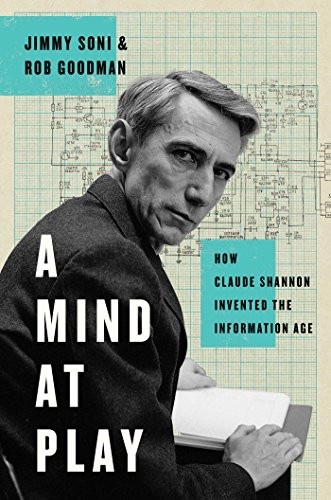
Cover of A Mind at Play

A Mind at Play

Jimmy Soni and Rob Goodman

4 ideas

  1. Information as surprise, stripped of meaning

    Shannon defined information not by what a message means but by how much it reduces uncertainty: the less predictable a symbol, the more information it carries, measured in bits. Separating information from meaning let a single mathematics cover telegraph, telephone, radio and later digital data, and it showed that any message can be encoded as binary choices.

  2. Master's thesis linking Boole to switching circuits

    As a 21-year-old MIT student working on Vannevar Bush's differential analyzer, Shannon saw that the on/off relay circuits he maintained could be described by George Boole's forgotten 19th-century algebra of logic. His 1937 master's thesis showed that circuits could be designed and simplified with true/false logic, and that circuits could therefore perform logic. It became the foundation of digital circuit design and has been called the most important master's thesis of the century.

  3. Noise can be beaten by encoding

    Shannon proved that every noisy channel has a definite capacity. Below that rate, messages can be sent with arbitrarily small error by adding carefully structured redundancy, rather than by simply boosting signal power. This turned reliable communication from an engineering hope into a mathematical limit that coding could approach, and it underlies error correction in modern data transmission.

  4. Curiosity-driven play as serious method

    Shannon picked problems because they amused him, not because they were useful or would win recognition, and he moved freely between foundational theory and toys like juggling machines, a maze-solving mechanical mouse and a flame-throwing trumpet. The book treats this as part of how he worked: play kept him on fundamentals, freed him from careerism, and made him willing to walk away from fields once they became crowded and fashionable.

Save and mark ideas in the app