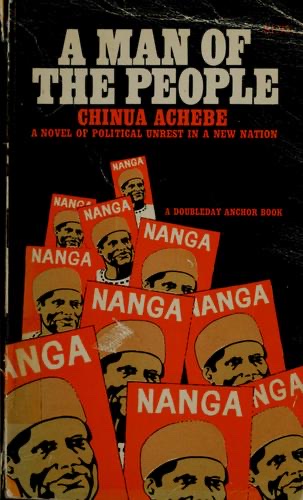
Cover of A Man of the People

A Man of the People

Chinua Achebe

10 ideas

  1. Odili's campaign against his old teacher

    Odili Samalu, a village schoolteacher, stays in the capital as guest of Chief Nanga, his former teacher and now a minister, until Nanga sleeps with Odili's girlfriend Elsie. Odili then contests Nanga's seat for a new opposition party and pursues Edna, the young woman Nanga means to take as a second wife. He is beaten at Nanga's rally and learns in hospital that his friend Max has been killed by a rival minister's thugs, and the violent election ends in a military coup.

  2. Village ownership restrains theft, national ownership doesn't

    The village punishes Josiah for his theft because the loss falls on people who feel they own what was taken, and so they act together against him. Odili explicitly says this restraint does not carry over to the nation, where no one feels the state belongs to them and a minister's theft provokes no comparable response.

  3. Independence as a scramble for shelter

    Odili pictures the colonized standing in the rain together until a few scrambled into the one shelter the departing rulers left and barricaded the door. The image explains why the new elite clings so fiercely to its newly won privileges and treats challengers as intruders, while still marking that grab as a betrayal of the shared struggle.

  4. Nanga's charm weakens his critics' judgment

    Much of Nanga's hold on people comes through warmth, jokes, and easy familiarity that make each listener feel personally favored. Even Odili, who despises what Nanga stands for, finds his judgment softened while staying in the minister's house, which shows how charm can dull criticism of a corrupt man.

  5. Idealists act from compromised private motives

    Odili enters politics to reform the country, but he is also openly driven by revenge over Elsie and by desire for Edna, and he keeps noticing this about himself. By making the reformer's motives mixed, the book denies the opposition any moral purity and suggests that personal grievance often supplies the energy that principle alone cannot. This leaves open whether the new men would govern differently once inside.

  6. Anti-intellectualism as a loyalty test

    Nanga's rise follows a crisis in which the Prime Minister sacks his university-educated ministers for opposing his economic policy and brands them traitors aligned with foreign interests. Backbenchers like Nanga prove their loyalty by denouncing learning itself. Education becomes a political liability, and the result is a government selected for loyalty and noise rather than competence.

  7. Pressure and bribery against the challenger

    Odili meets harassment and attempted attacks as soon as he campaigns, and Nanga later offers him money and a foreign scholarship to withdraw. When he refuses, the pressure grows to include his father, who loses his local post, so the regime pairs intimidation with offers of a price throughout.

  8. Captured election opens the way to coup

    With ballots, thugs, patronage, and the press serving the ruling party, the election gives voters no real chance to remove it. When the party's election thugs go out of control, the resulting disorder gives the army its opportunity to seize power, and the novel presents the coup as an outcome of that system, not a cure.

  9. Public opinion follows power, not principle

    After the coup, the newspapers, officials, and crowds that praised Nanga immediately denounce the fallen ministers as if they had always opposed them. Odili concludes that the people's cynicism and complicity did not change, only the direction of their flattery. Popular condemnation of a toppled leader is therefore weak evidence of real moral awakening.

  10. Unpaid avenging marks the rare good death

    Max's lover Eunice shoots Chief Koko, the minister whose thugs killed Max, and Odili reflects on it at the end of the novel. In a regime where people act only for a fee, he says, a man dies a good death only if his life moved someone to avenge him without asking to be paid. The measure of integrity is disinterested loyalty, which the whole system has trained out of almost everyone.

Save and mark ideas in the app