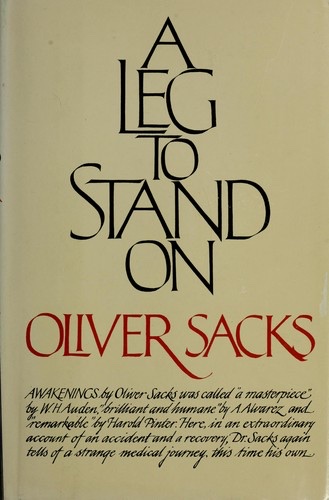
Cover of A Leg to Stand On

A Leg to Stand On

Oliver Sacks

4 ideas

  1. Neurologist's leg feels alien after Norway fall

    In 1974, alone on a Norwegian mountain, Oliver Sacks fled a bull, fell, and tore the quadriceps tendon of his left leg, then splinted it and dragged himself down until reindeer hunters found him. After surgical repair in London the leg felt alien to him, an inert object that was not part of him, and for weeks he could neither feel it as his own nor move it voluntarily. Recovery came in stages: a sudden return of movement, then setbacks and a longer rehabilitation.

  2. Proprioceptive scotoma: a limb erased from self

    Sacks describes the loss of a body part from the brain's internal map as a 'scotoma', a gap in which the limb is not just numb but ceases to exist as part of the self. Without proprioceptive input the leg becomes a foreign object, and even the memory of how to own and move it disappears. On this account, ownership of the body is a continuously maintained neural construction, not a given, and it can collapse locally while everything else stays intact.

  3. Music sparks the return of walking

    For Sacks, walking came back spontaneously when he heard Mendelssohn's Violin Concerto in his head and it restored his sense of rhythm and flow. He describes skilled action as a 'kinetic melody', an integrated temporal whole, and takes his experience as a sign that music and rhythm can help recover motor function. This breakthrough was followed by setbacks and further rehabilitation, not a complete recovery all at once.

  4. Doctor as patient exposes medicine's blind spot

    As a patient, Sacks found his surgeon brushing aside his reports that the leg felt absent. The experience showed him how medicine turns the subjective, first-person experience of illness into an objective 'case' that is repaired but never heard. Seeing care from inside the bed shows the patient's isolation, dependency and fear, which clinical detachment is built to ignore. It argues for a neurology that takes identity and lived experience as real data.

Save and mark ideas in the app