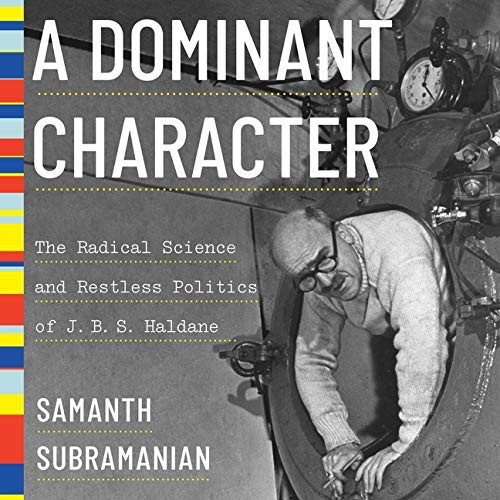
Cover of A Dominant Character

A Dominant Character

Samanth Subramanian

4 ideas

  1. Lysenko affair forces a loyalty choice

    When Stalin's regime backed Trofim Lysenko's rejection of Mendelian genetics, Haldane was caught between the Communist Party and the science he had helped found. He equivocated publicly for years instead of condemning Lysenkoism outright, then quietly drifted away from the party. The episode shows how ideological commitment can pressure a scientist to hold back a judgment his own expertise makes obvious.

  2. Self-experimentation as scientific ethic and method

    Haldane, following his physiologist father, used his own body as the experimental subject: he breathed toxic gases, sat in decompression chambers and drank acid solutions to study physiology. The book presents this as a moral stance, not just bravado. A researcher who takes the risk himself earns the standing to ask it of others and gets data unavailable from animal models, at a real cost to his health.

  3. Mathematical synthesis of Darwin and Mendel

    Haldane, with Fisher and Wright, showed mathematically that natural selection acting on Mendelian genes could produce evolutionary change at measurable rates. His calculations, such as those for the peppered moth's industrial melanism, turned selection from a qualitative story into quantifiable population genetics. This reconciled two theories that had been seen as rivals and founded the modern evolutionary synthesis.

  4. Politics and science as mutually shaping

    Haldane's Marxism and his science fed each other. His materialist worldview drew him to explanations built from mechanisms and numbers, and his scientific prestige gave his political journalism authority, as in the Daily Worker columns. Reading a scientist's career this way shows how his choices of problems, his public voice and his blind spots come from the same convictions that drive his politics.

Save and mark ideas in the app