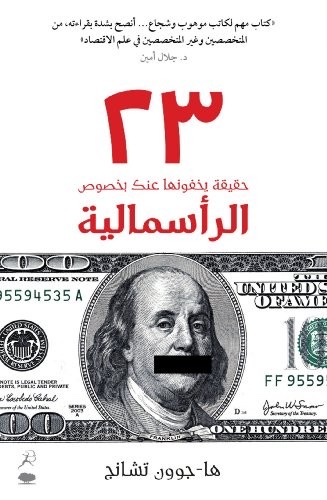
Cover of 23 Things They Don't Tell You About Capitalism

23 Things They Don't Tell You About Capitalism

Ha-Joon Chang

6 ideas

  1. There is no such thing as free markets

    Every market rests on political choices about what can be traded, by whom, and under what conditions. Examples include child labour bans, licensing rules, and immigration controls. A market looks 'free' only because its regulations have become so accepted that they are invisible, so the real debate is always about which rules to have, never whether to have rules at all.

  2. Rich countries kicked away the ladder

    Today's rich countries, including Britain and the United States, industrialised behind high tariffs, subsidies, and state support for infant industries. Once they were rich, they preached free trade to developing countries. Protectionism was therefore the historical path to development, not an obstacle to it.

  3. Washing machine mattered more than internet

    Household technologies like washing machines, piped water, and electricity changed economies more than the internet. They freed women's labour for the paid workforce and restructured the family. People overrate recent technologies because they are new and visible, and this bias distorts policy toward chasing the latest innovation.

  4. Bus driver wages across rich and poor

    A bus driver in Sweden earns roughly fifty times what a bus driver in India earns, although the Indian driver is probably more skilled at navigating chaotic traffic. The wage gap comes from immigration controls that shield rich-country workers from competition, and from the productivity of the economy around the worker. Individual productivity explains little of it, which undercuts the idea that market wages reflect personal merit.

  5. Shareholders are the least committed stakeholders

    Shareholder-value maximisation hands control of firms to the stakeholders who can exit most easily by selling their shares. Workers and suppliers, who are tied to the firm's long-term fate, get less say. This pushes managers toward buybacks, dividends, and short-term profit at the expense of investment, weakening companies over time.

  6. Trickle-down redistribution failed to deliver growth

    Upward redistribution to the rich through tax cuts and deregulation was justified as a way to boost investment and growth for everyone. Since the 1980s, growth in most economies that adopted it has been slower than in the more egalitarian postwar decades. Meanwhile inequality rose, which shows that concentrating income at the top does not reliably turn into broader prosperity.

Save and mark ideas in the app